Trip Planner Apps Without a Subscription (Yes, They Exist)
Most big-name trip planner apps now charge a yearly subscription — TripIt Pro is $49 a year, Wanderlog Pro about $40, Tripsy Pro $59, Roadtrippers Premium $59.99. But a trip planner app with no subscription does exist: some apps have genuinely usable free tiers, and a few charge a small one-time price for everything. This guide sorts the honest options from the trial traps.
Why does every trip planner app want a subscription?
Because subscriptions are better for the developer, not for you. A one-time $30 sale is worth $30; a $40-a-year subscriber who forgets to cancel is worth $200 over five years. Investors value recurring revenue, app stores make renewals frictionless, and so almost every travel app that raised money or grew a team has moved to the subscription model.
The awkward part is that trip planning is not a subscription-shaped problem for most people. If you take one or two trips a year, you need the app intensely for a few weeks and not at all for the other eleven months — but the subscription charges you for all twelve. That mismatch is why “trip planner app no subscription” is a search people type in visible frustration, usually right after a renewal notification.
The good news: subscription-free options exist. The bad news: you have to read carefully to find them, because “free” and “one-time” are used loosely in this market. Here is what the major apps actually charge, verified in July 2026.
Which trip planner apps charge a subscription?
The four biggest names in trip planning are all subscription products:
| App | Paid tier | Price (verified July 2026) | One-time option? |
|---|---|---|---|
| TripIt | TripIt Pro | $49/year | No |
| Wanderlog | Wanderlog Pro | ~$40/year (annual only) | No |
| Tripsy | Tripsy Pro | $59/year | Yes — $299 lifetime |
| Roadtrippers | Premium | $59.99/year or $19.99/month | No |
A few notes on each:
- TripIt Pro ($49/year). The free TripIt tier builds itineraries from forwarded confirmation emails and is usable on its own. Pro adds the flight-tracking layer: real-time delay alerts, alternative flight search, seat tracking. Useful if you fly constantly for work; hard to justify for two leisure trips a year. We compare it in depth in our TripIt vs Wanderlog vs Travel Stories piece.
- Wanderlog Pro (about $40/year). Sold as an annual plan only — there is no monthly option — with a 7-day free trial. Regional pricing varies slightly. The free tier is the most generous of the big four, but see the trial-trap section below for the catch.
- Tripsy Pro ($59/year). The most expensive annual plan here, though Tripsy deserves credit for being one of the few to offer a lifetime alternative at $299. That is roughly five years of subscription paid up front — a real option, but a serious commitment for a trip planner.
- Roadtrippers Premium ($59.99/year). Focused on North American road trips. The free version is closer to a demo, with the trip-length and offline features held for Premium.
None of these are scams — they are real products with real features. The problem is subtler: the pricing patterns around them are designed to move you from “free” to “paying yearly” without a clear moment of decision.
What are the trial traps to watch for?
Two patterns account for most of the money people spend on travel apps by accident.
Trap 1: the auto-renewing trial
The standard flow: a 7-day (Wanderlog) or 30-day (TripIt Pro) free trial that requires you to start the subscription up front. The trial converts to a paid year automatically unless you cancel. You download the app in June while excited about a trip, the trip happens, and in July you are billed $40-49 for a year you will mostly not use.
The defence is mechanical, not moral — nobody remembers to cancel by willpower alone:
- When you start any trial on iPhone, cancel it immediately in Settings → [your name] → Subscriptions. You keep full access until the trial expires, and it never converts.
- If a trial requires payment details before you have seen the product, treat that as the price tag it is.
Trap 2: “free” with the core paywalled
The second pattern is the free tier that works beautifully at home and fails abroad. Wanderlog is the clearest example: unlimited trips and collaborative planning cost nothing, but offline access is a Pro feature. You discover this standing in a foreign metro station with no signal, trying to load the itinerary you built — and the upgrade prompt appears at the exact moment you cannot comparison-shop. Route optimisation and exports sit behind the same paywall.
This is not unique to Wanderlog. Before trusting any free tier, ask one question: does it still work with no internet, no account, and no payment? If the answer is no, the free tier is a storefront, not a product.
Trap 3: “lifetime” that is not what it sounds like
Smaller but worth knowing: some apps sell “lifetime” unlocks per feature pack rather than for the whole app, or price the lifetime option so high (Tripsy’s is $299) that it functions mainly to make the subscription look cheap by contrast — a classic pricing anchor. A lifetime price is only meaningful if it is a number you would happily lose.
Which trip planner apps have no subscription at all?
Ranked by how completely they avoid the subscription model:
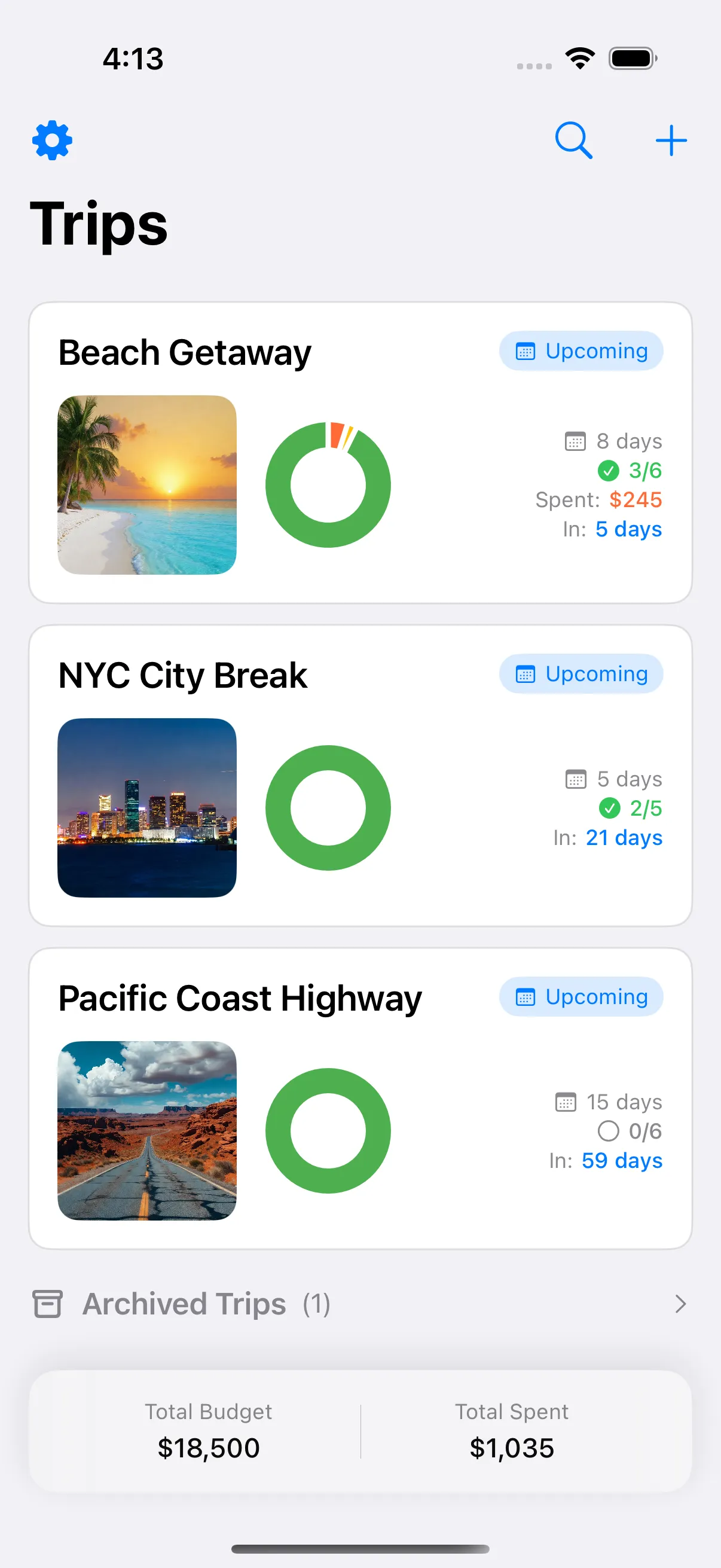
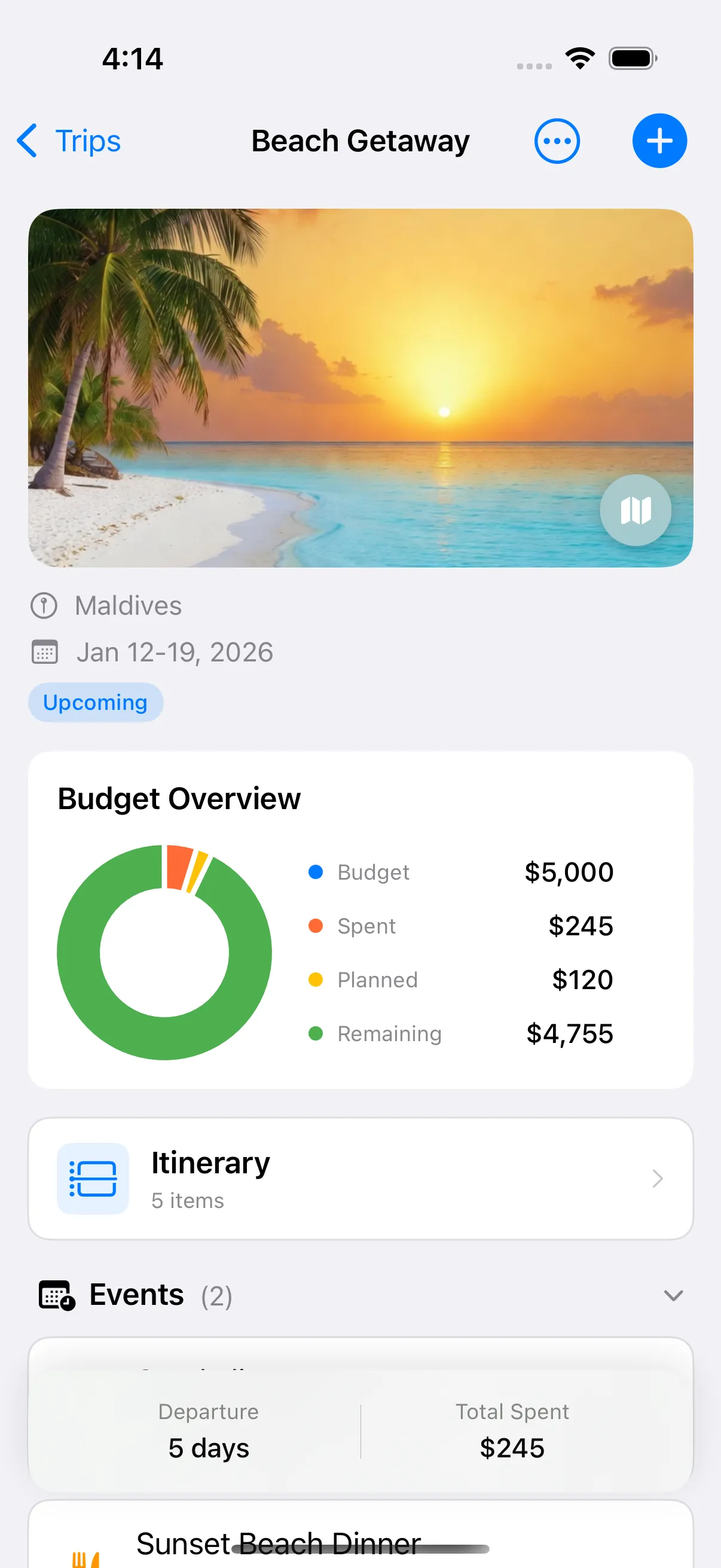
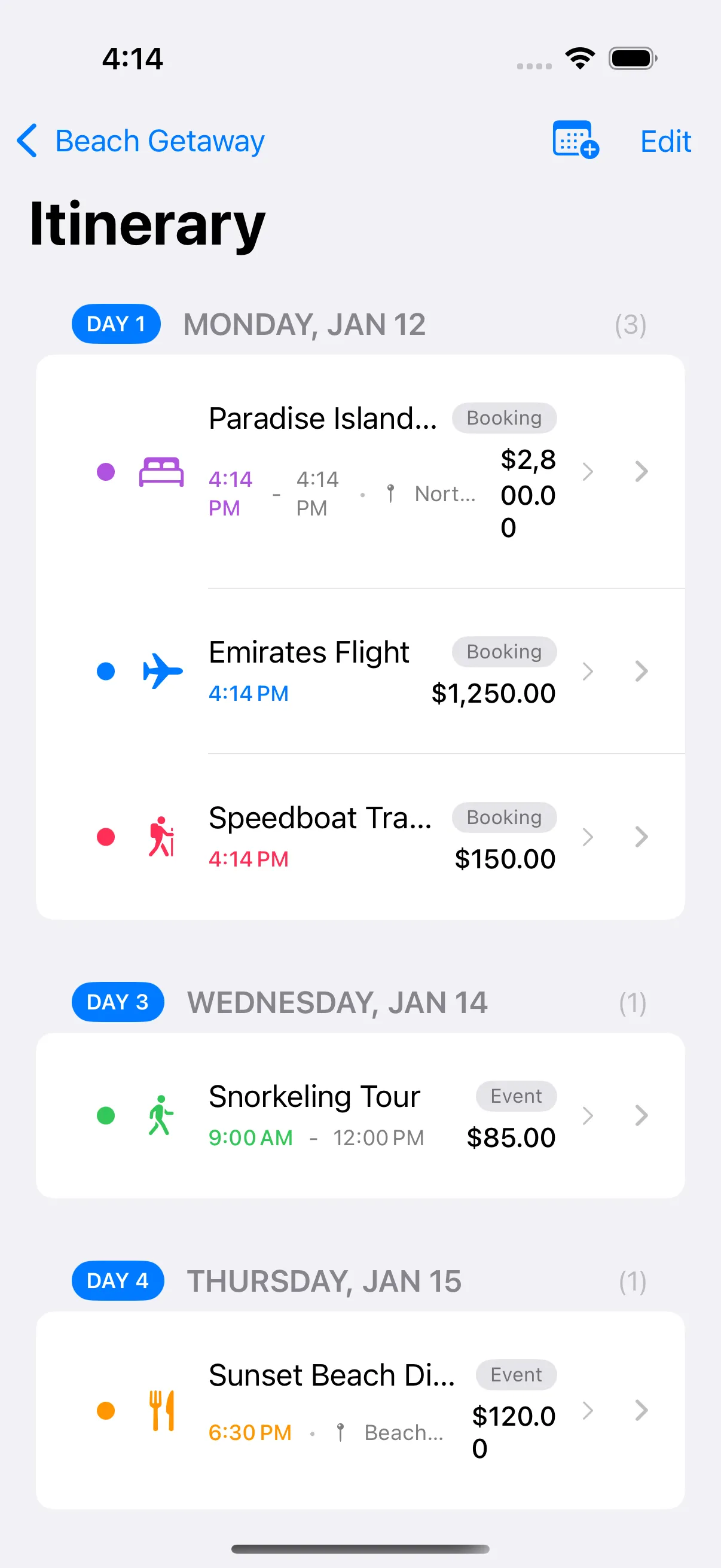
- Travel Stories — free for one trip, $1.99 one-time for everything. The free plan is one trip with every feature included: day-by-day itinerary with maps, bookings, tasks, expense tracking against a budget, packing lists with 100+ suggestions, and a travel diary with photos. It works fully offline with no account, because your data stays on the device — there is no server to sync to. Premium Lifetime is a $1.99 one-time purchase (19 DKK) that unlocks unlimited trips, visual spending charts, Apple Calendar export, and trip sharing. There is no subscription tier to upsell you to; if you plan more than one trip and want everything unlocked, the Travel Stories app on the App Store costs less than the airport coffee you will drink while using it. iPhone only, iOS 17 or later.
- TripIt (free tier). If all you want is confirmation emails turned into a chronological itinerary, the free tier does that indefinitely without payment. You give up the Pro flight alerts, and TripIt is cloud-based, so it needs an account — but as a no-cost baseline it is honest.
- Wanderlog (free tier, with the offline caveat). Genuinely capable for collaborative planning while you have signal. Fine for planning at home; risky as your only tool on the road, for the offline reason above.
- Tripsy (lifetime, $299). The only big-name competitor selling a true buy-once option. The price makes sense only for very frequent travellers who are certain they will use it for many years.
- Free web tools. Not planners, but genuinely free and genuinely useful: our own packing list generator builds a categorised list from trip type, length, and climate with no download, no account, and no payment — the test we just asked you to apply to free tiers.
- Apple Notes, Google Maps lists, and a spreadsheet. The zero-cost stack. It works — people planned trips this way for decades — but you assemble everything by hand and nothing connects: the map does not know your schedule, the budget does not know your bookings. Our roundup of the best trip planner apps covers when the DIY stack stops being worth the savings.
How do you check an app’s real price before downloading?
Ninety seconds on the App Store page tells you almost everything:
- Scroll to “In-App Purchases” in the Information section. This list is the truth, whatever the screenshots say. Items marked per month or per year are subscriptions; a single fixed price is a one-time unlock.
- Count the tiers. One or two purchase options usually means simple pricing. Six-plus tiers with overlapping names (“Pro Monthly”, “Pro Annual”, “Premium Plus”) usually means a pricing structure built for confusion.
- Read the three most recent critical reviews. Billing complaints cluster fast and reviewers name the exact pattern — “charged after cancelling”, “trial converted without warning”.
- Check what the free tier excludes. If reviews mention hitting a paywall mid-trip, believe them.
The pricing model also tells you something about incentives. A subscription app needs you to keep needing it, which rewards complexity and lock-in. A one-time-purchase app only needs you to be satisfied once, and a free tier with everything included is betting you will like the product enough to pay a small amount for more. That second bet is the one aligned with you actually enjoying your trip.
Plan the trip, skip the renewal
The subscription model won trip planning by default, not by merit — for one or two trips a year it charges you for months of nothing. Before your next trip, pick your tool deliberately: a free tier that works offline, a one-time purchase you will not resent, or the manual stack if you enjoy the tinkering. Then put the money you saved into the trip itself; if you need a starting point, our guide on how to plan a trip step by step walks the whole sequence. And if you want one honest answer instead of a comparison spreadsheet: Travel Stories, free for your next trip with everything included, $1.99 once if you never want to think about travel-app pricing again.
Ready-made packing lists for this
Free, no sign-up: tick items off in the browser, print it, or adjust it to your own trip.
7-day beach trip packing list
A week at the beach, itemised with real quantities: two swimsuits, five outfits, and how much sunscreen a week actually takes. Print it or check it off online.
What to pack for Bali
A Bali packing list covering temple sarongs, reef-safe sunscreen, scooter safety, and why laundry at a dollar a kilo means you should pack for four days, not ten.
Camping packing list
A camping list organised by the three systems that matter — shelter, sleep and cook — plus the R-value most people ignore and the tarp that doubles your usable space.
Festival packing list
A festival list for the conditions rather than the photos: mud, no charging, no shade, banned glass, and a tent you have to find again at 2am.
Or build one from scratch with the packing list generator.
Frequently asked questions
Are there any trip planner apps without a subscription?
Yes. TripIt and Wanderlog both have free tiers you can use indefinitely without paying, though each holds back features for its paid plan. For a one-time purchase, Tripsy sells a $299 lifetime licence and Travel Stories sells a $1.99 lifetime Premium. Travel Stories is also fully featured on its free plan for a single trip, so you can test everything before spending anything.
How much does TripIt Pro cost?
TripIt Pro costs $49 per year as of mid-2026, on top of a free tier that builds itineraries from forwarded confirmation emails. Pro adds real-time flight alerts, alternative flight search, and seat tracking. There is no one-time purchase option — if you stop paying, the Pro features stop.
Is Wanderlog really free?
The free tier is genuinely usable: unlimited trips, collaborative planning, and maps cost nothing. But Wanderlog Pro, at about $40 per year, holds back offline access, route optimisation, and exports. Offline access is the feature most people discover they need mid-trip, in a place with no signal, which makes the free tier riskier than it first appears.
What is a lifetime purchase in an app?
A lifetime (or one-time) purchase means you pay once and keep the features permanently, with no renewal. Tripsy offers one at $299 and Travel Stories at $1.99. Check the App Store listing's in-app purchase section before downloading: if every item says 'per year' or 'per month', there is no one-time option regardless of what the marketing implies.
How do I avoid auto-renewing free trials in travel apps?
On iPhone, a trial started through the App Store can be cancelled immediately in Settings, then your Apple account name, then Subscriptions — you keep the trial until it expires but it will not renew. Better still, check the in-app purchase list on the App Store page before installing. If the headline offer is a trial that needs payment details up front, assume it will convert to a paid year unless you act.
Keep reading

Best Trip Planner Apps for iPhone: An Honest Comparison
An honest look at TripIt, Wanderlog, Google Maps lists, Notion, and Travel Stories — who each trip planner app is really best for, from the maker of one.

How to Plan a Trip Step by Step: A Complete 9-Step Guide
Learn how to plan a trip step by step — pick dates, set a budget, book transport, build an itinerary, pack, and track spending in one simple system.

TripIt vs Wanderlog vs Travel Stories: 2026 Comparison
TripIt Pro costs $49/year, Wanderlog Pro $39.99/year, Travel Stories $1.99 once. An honest three-way comparison of what each trip planner does best.