Best Trip Planner Apps for iPhone: An Honest Comparison
The best trip planner app depends on how you travel: TripIt is the strongest pick for frequent business travelers, Wanderlog for groups planning together, and Travel Stories for travelers who want offline planning plus memories without a subscription or account. Full disclosure up front: Travel Stories is our app — so below we tell you plainly when a competitor is the better choice.
How should you choose between the best trip planner apps?
Most roundups of the best trip planner apps read like the author never used any of them — every app is “great,” and somehow the sponsor wins. Let’s do this differently. First, the disclosure: Travel Stories is our app. I built it, and this article exists on its website. So instead of pretending neutrality, I’ll be specific about who each app genuinely serves best — including the cases where you should pick a competitor over ours.
The honest starting point is that “trip planner app” describes at least four different jobs:
- Organizing bookings you have already made (flights, hotels, confirmations)
- Planning together with other people on a shared itinerary and map
- Collecting places you want to visit
- Running the whole trip — dates, budget, tasks, packing, documents, and the memories afterwards
No single app is best at all four. Match the app to the job and you cannot go far wrong. Here are the five serious options for iPhone.
TripIt: best for frequent business travelers
TripIt has been around for a long time, and its core trick is still its best feature: forward your booking confirmation emails to it, and it assembles them into a chronological itinerary automatically. Flight, hotel, rental car, restaurant reservation — it parses the emails so you do not retype anything.
- Pricing model: free tier with the core email-to-itinerary feature; TripIt Pro is a paid subscription that adds travel-day extras such as flight alerts and airport navigation help.
- Best for: people who travel often — especially for work — and whose main problem is volume of bookings. If you take many flights a year, the automation and the Pro alerts genuinely pay for themselves in saved hassle.
- Where it falls short: TripIt organizes what you have booked; it is not really for the planning that happens before booking, and things like budgets, packing lists, or trip photos are not what it is for. If your trips are one or two vacations a year, a subscription for booking automation is usually more machinery than the problem needs.
Honest verdict: if you are a road-warrior consultant with three flights a month, stop reading and get TripIt. It is the best tool for that life, and ours is not.
Wanderlog: best for planning a trip with other people
Wanderlog is built around collaborative itineraries: you and your travel companions edit the same day-by-day plan, drop places onto a shared map, and vote ideas up or down. For group trips — a friends’ week away, a multi-family vacation — this solves the real problem, which is that group planning otherwise happens in a chat thread nobody can find anything in.
- Pricing model: freemium — a capable free tier, with a Pro subscription unlocking extras.
- Best for: groups planning together, and map-centric planners who think in “places on a map” more than “lines in a list.”
- Where it falls short: if you travel solo or as a couple, the collaboration machinery is weight you do not need, and as with any subscription tool, the features you like best have a monthly cost attached. It is also account-based by design — that is what makes sharing work.
Honest verdict: for genuinely collaborative planning, Wanderlog is the strongest option on this list. Travel Stories is not trying to win the six-friends-planning-together use case; Wanderlog already does it well.
Google Maps lists: best free way to save places — but not a planner
Everyone already has Google Maps, and its saved lists (“Want to go,” custom lists per city) are a frictionless way to collect restaurants, sights, and neighborhoods while you research. Lists can be shared, and the places sit right there in the app you will navigate with anyway.
- Pricing model: free.
- Best for: the collecting phase of any trip, for everyone. Honestly, use it alongside whatever planner you pick — we do.
- Where it falls short: a list of pins is not a plan. There are no dates, no day-by-day structure, no budget, no bookings, no documents, no checklist. Google Maps tells you what interested you, not when you will do it or whether you can afford it.
Honest verdict: not a competitor so much as a companion. Collect in Maps; plan somewhere with dates and structure. If you want the structure part explained, see our guide to planning a trip step by step.
Notion and spreadsheets: best for people who love building systems
Some travelers plan trips in Notion pages or a Google Sheet, and when it works, it works because the person enjoys the building as much as the trip. Total flexibility: your columns, your structure, your rules. Cost: typically nothing, since you already have these tools.
- Pricing model: free for personal use in the tiers most travelers need.
- Best for: spreadsheet-brained planners, unusual trips that no app’s structure fits, and anyone who wants full control of the format.
- Where it falls short: everything is manual — every table, every formula, every category is yours to build and maintain. And the mobile experience is the real problem: editing a spreadsheet on a phone in a taxi is nobody’s idea of fun, and web-first tools are at their weakest exactly when travel needs them — offline, abroad, in airplane mode.
Honest verdict: a great choice for a certain temperament, and no app will convert the true spreadsheet devotee. But if you have ever stood in a hotel lobby pinch-zooming a sheet that will not load without Wi-Fi, you already know the weakness.
Travel Stories: best for offline planning plus memories, without a subscription
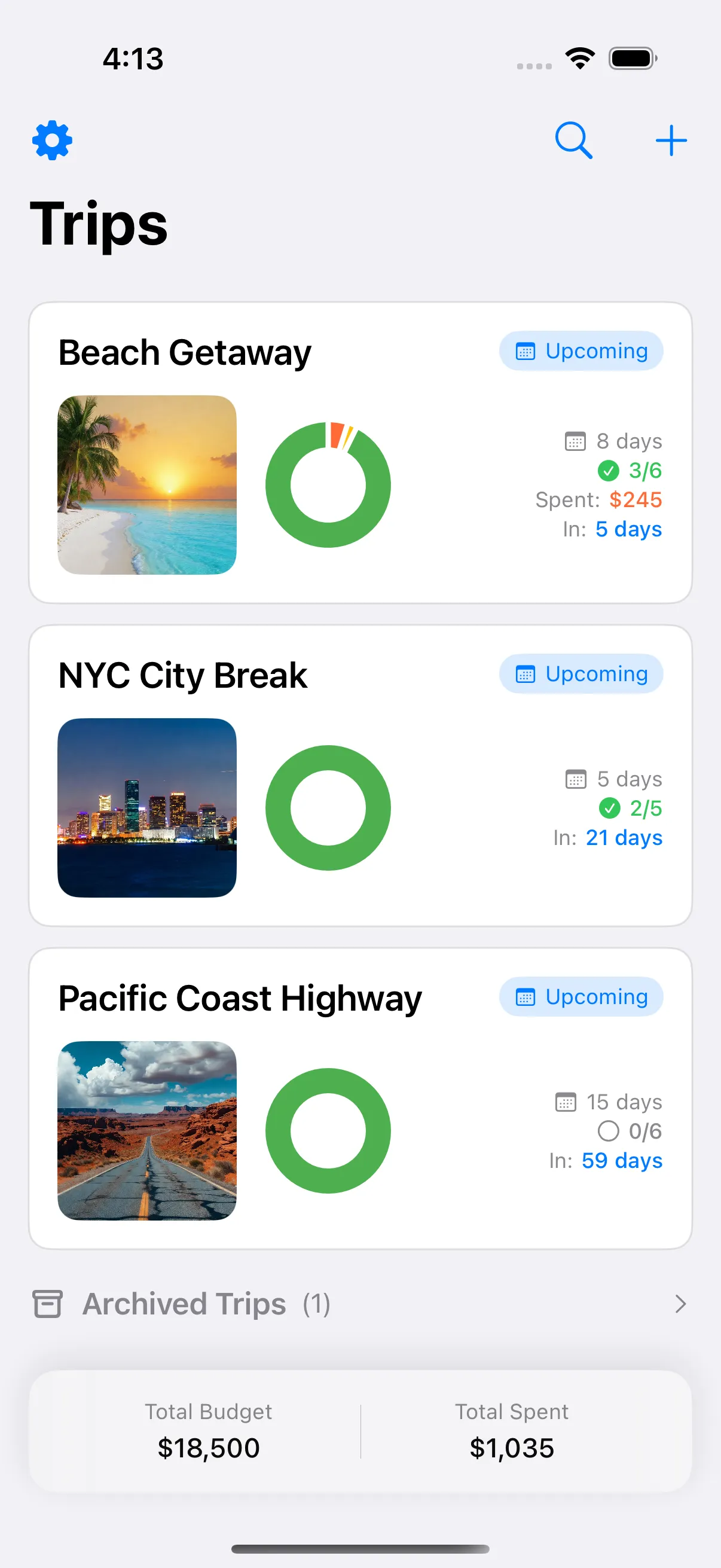
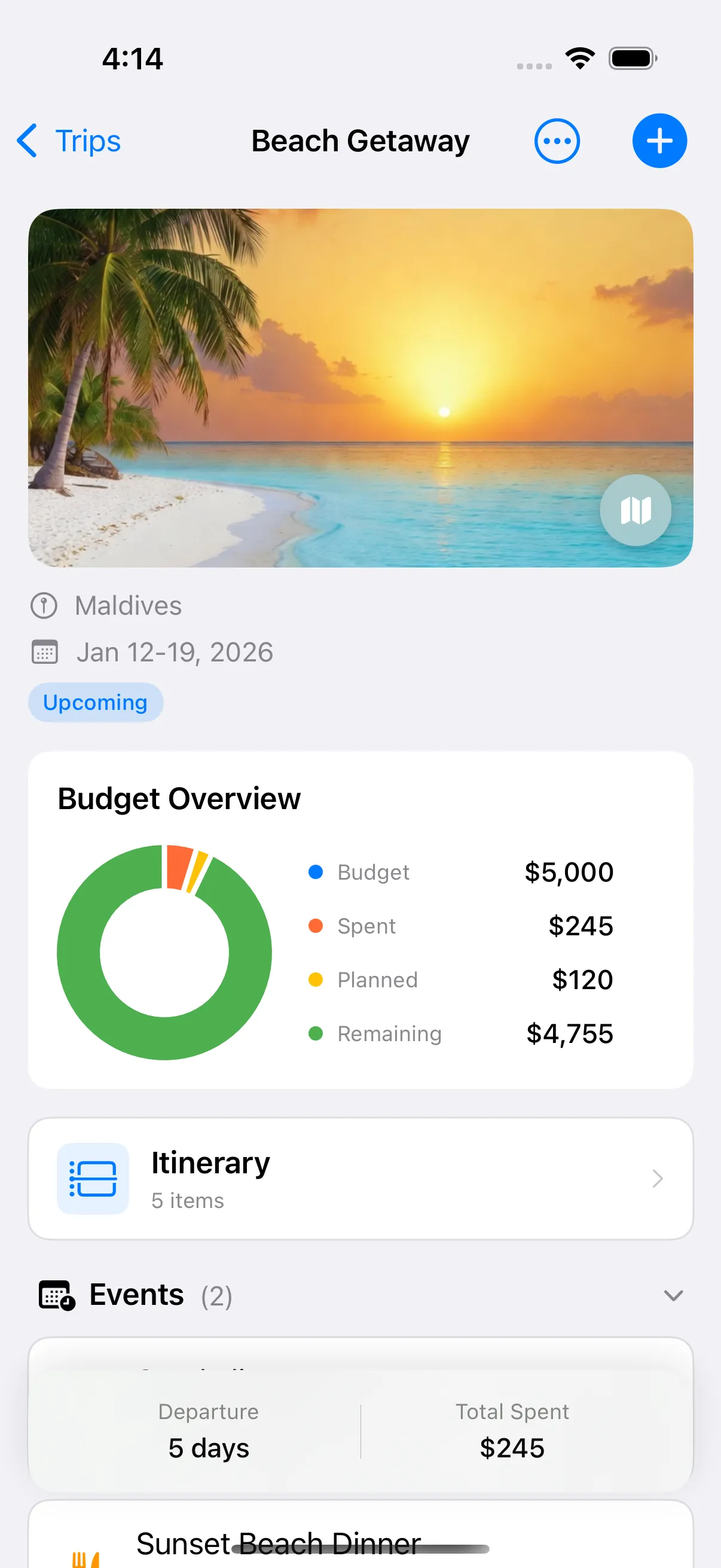
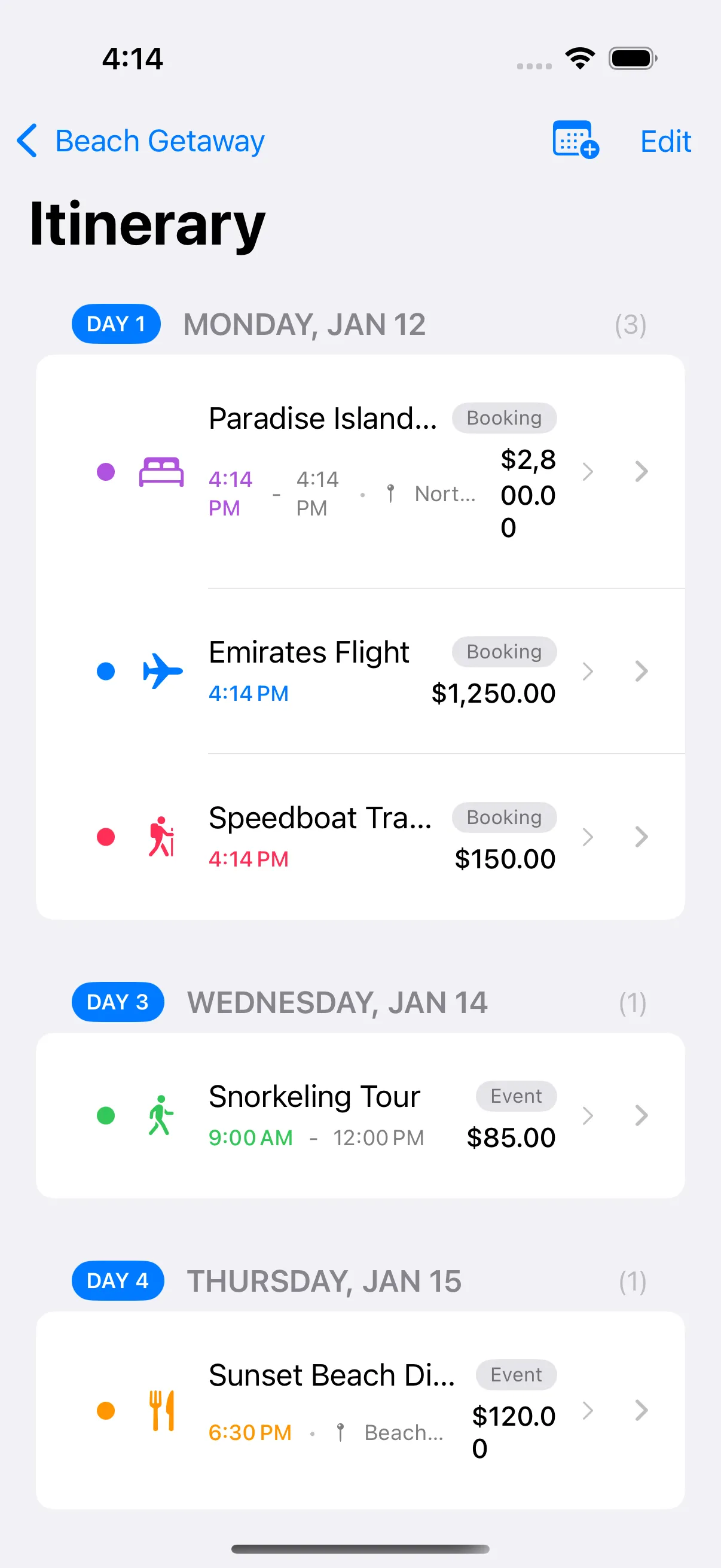
Now our own app, held to the same standard. Travel Stories is a free iPhone app (iOS 17+) that keeps the whole trip in one place: the trip itself with destination, dates, budget, and a cover image; a day-by-day itinerary; task checklists; bookings with prices and confirmation numbers; document storage for boarding passes, reservations, and insurance; notes; packing lists with suggested items; expense tracking against your budget with charts; and a photo memories timeline for after the trip. If you want to sample the thinking before installing anything, our packing list generator runs free in the browser with no sign-up.
Three deliberate choices set it apart from everything above:
- It works offline. Everything lives on your iPhone. Itinerary, documents, budget — all there in airplane mode, in a dead zone, or with roaming switched off.
- No account. You download it and start planning. There is no sign-up, no login, and no server holding your travel documents.
- One-time purchase, no subscription. The app is free to download and use; a single Premium upgrade of about $1.99 — paid once — unlocks the full experience. There is no monthly fee, which we think fits how normal people travel: a few trips a year, not a recurring service.
The memories side matters too: the same app that held the plan holds the photo timeline and notes afterwards, which quietly turns each trip into a keepsake — more on that in our guide to keeping a travel journal.
- Best for: solo travelers, couples, and families who want planning, budget, documents, and memories in one private, offline app — and who are tired of subscriptions.
- Where it falls short: it does not auto-import bookings from email like TripIt, and it is not a real-time collaborative planner like Wanderlog. It is iPhone-only. If those are your must-haves, pick accordingly — see above.
If that trade-off sounds like your kind of travel, you can download Travel Stories free from the App Store and try it on your next trip before deciding whether the one-time upgrade is worth it.
Comparison table: trip planner apps at a glance
| TripIt | Wanderlog | Google Maps lists | Notion / sheets | Travel Stories | |
|---|---|---|---|---|---|
| Pricing model | Free + Pro subscription | Freemium subscription | Free | Free (personal tiers) | Free + one-time ~$1.99 upgrade |
| Account required | Yes | Yes | Google account | Yes (Notion) | No |
| Works fully offline | Partial | Partial | Partial | Weak on mobile | Yes |
| Auto-import bookings from email | Yes — its core feature | No | No | No | No |
| Group collaboration | Limited | Yes — its core feature | List sharing only | Possible, manual | No |
| Day-by-day itinerary | Yes (from bookings) | Yes | No | Manual | Yes |
| Budget + expense tracking | No | Partial | No | Manual | Yes, with charts |
| Document storage | Yes | Partial | No | Manual | Yes |
| Packing lists | No | Partial | No | Manual | Yes, with suggestions |
| Photo memories / journal | No | Partial | No | Manual | Yes, timeline |
| Best for | Frequent flyers | Group trips | Saving places | System builders | Offline all-in-one, no subscription |
Rows for competitors reflect their general, publicly known feature sets; tiers and details change, so check current listings before buying any subscription.
So which trip planner app should you get?
Skip the suspense — match yourself to a row:
- You fly constantly, mostly for work: TripIt. The email automation is the killer feature and nothing else here replaces it.
- You are planning a group trip with shared decisions: Wanderlog. Collaborative planning is its home turf.
- You just want to remember places you have heard about: Google Maps lists, today, for free — and pair it with a real planner when dates get involved.
- You love building your own system and live in your spreadsheet: Notion or a sheet. Just be honest with yourself about the offline mobile experience.
- You take a few personal trips a year and want everything — plan, budget, documents, packing, photos — in one offline app with no account and no subscription: Travel Stories. That is precisely the traveler we built it for, right down to tracking your budget inside the same app that holds the itinerary.
The pattern worth noticing: the subscription apps earn their fee when travel is frequent or collaborative, because automation and sync are ongoing services. For everyone else, paying monthly for a few trips a year is the mismatch — which is exactly why we priced Travel Stories as a one-time purchase.
Put it into practice
Pick the app that matches how you actually travel, set up your next trip in it this week while motivation is high, and let the tool carry the details. If that traveler in the last row sounded like you, Travel Stories is free on the App Store and keeps your whole trip — plan, budget, documents, and memories — on your iPhone, online or off.
Ready-made packing lists for this
Free, no sign-up: tick items off in the browser, print it, or adjust it to your own trip.
Two-week Europe packing list
A multi-city Europe list built around the bag you carry up a fourth-floor walk-up: one laundry stop, three plug types, and 15°C of variation between north and south.
What to pack for Japan in winter
A winter Japan packing list built around what actually catches visitors out: constant shoe removal, cash-only counters, brutal indoor heating, and tiny hotel rooms.
Family beach holiday packing list
A week at the beach with children: UV swimsuits instead of endless sunscreen reapplication, the shade you have to bring yourself, and the wet bag that saves the car.
Carry-on only packing list
Travelling with hand luggage only: the liquids bag is the real constraint, not the clothes. Solid swaps, the roll method, and the two things that never leave your body.
Or build one from scratch with the packing list generator.
Frequently asked questions
What is the best free trip planner app?
It depends on what you need for free. Google Maps lists cost nothing and are great for saving places, but they do not handle dates, budgets, or bookings. TripIt and Wanderlog both have useful free tiers with paid subscriptions on top. Travel Stories is free to download with full core planning features and a one-time upgrade instead of a subscription.
Is TripIt worth it for casual travelers?
For one or two trips a year, TripIt's headline feature — automatically building itineraries from forwarded booking emails — matters less, because you have fewer bookings to organize. Its Pro subscription earns its keep for people who fly often and want flight alerts. Casual travelers usually do fine with a simpler app or even the free TripIt tier.
Do trip planner apps work offline?
Not all of them, and it matters more than people expect, because trips are exactly when you face roaming charges, dead zones, and airplane mode. Web-first tools like Notion are weakest offline on mobile. Travel Stories stores everything on your iPhone and works fully offline, including your documents and itinerary.
Can I plan a trip without creating an account?
With most trip planner apps, no — TripIt and Wanderlog are built around accounts, since they sync email and enable collaboration. If you would rather not create yet another login, Travel Stories requires no account at all; your data lives on your device.
Should I just use a spreadsheet to plan my trip?
A spreadsheet is genuinely fine if you enjoy building it and your trip is simple. You get total flexibility and it costs nothing. The trade-offs are that everything is manual, phone editing is clumsy, and there is no natural home for documents, photos, or day-by-day views. If you find yourself fighting the spreadsheet, that is the sign to switch to a dedicated app.
Keep reading

How to Plan a Trip Step by Step: A Complete 9-Step Guide
Learn how to plan a trip step by step — pick dates, set a budget, book transport, build an itinerary, pack, and track spending in one simple system.

Trip Planner Apps Without a Subscription (Yes, They Exist)
Tired of $40-60/year trip planner subscriptions? Here are the apps that are genuinely free or one-time purchases, and the trial traps to avoid.

TripIt vs Wanderlog vs Travel Stories: 2026 Comparison
TripIt Pro costs $49/year, Wanderlog Pro $39.99/year, Travel Stories $1.99 once. An honest three-way comparison of what each trip planner does best.