TripIt vs Wanderlog vs Travel Stories: 2026 Comparison
TripIt is the best app for automatically organising bookings — forward a confirmation email and your itinerary builds itself, with Pro at $49 per year. Wanderlog is the best app for planning a trip with other people on a shared map, with Pro at $39.99 per year. Travel Stories is a simpler iPhone-only planner that covers itinerary, budget, packing, and a travel diary offline with no account, for a one-time $1.99 instead of a subscription.
What is the real difference between TripIt, Wanderlog, and Travel Stories?
These three apps get compared constantly, but they were built to solve three different problems.
TripIt organises trips you have already booked. Its signature trick is email forwarding: send any confirmation email — flight, hotel, rental car, restaurant — to [email protected] and it parses the details into a chronological itinerary automatically. It is the closest thing to a personal travel assistant that runs on autopilot.
Wanderlog helps you decide what a trip should be. It is a collaborative, map-first planner: you and your travel companions save places, drag them into days, see everything plotted on a shared map, and edit the plan together in real time. It also includes group expense tracking with cost splitting, even on the free tier.
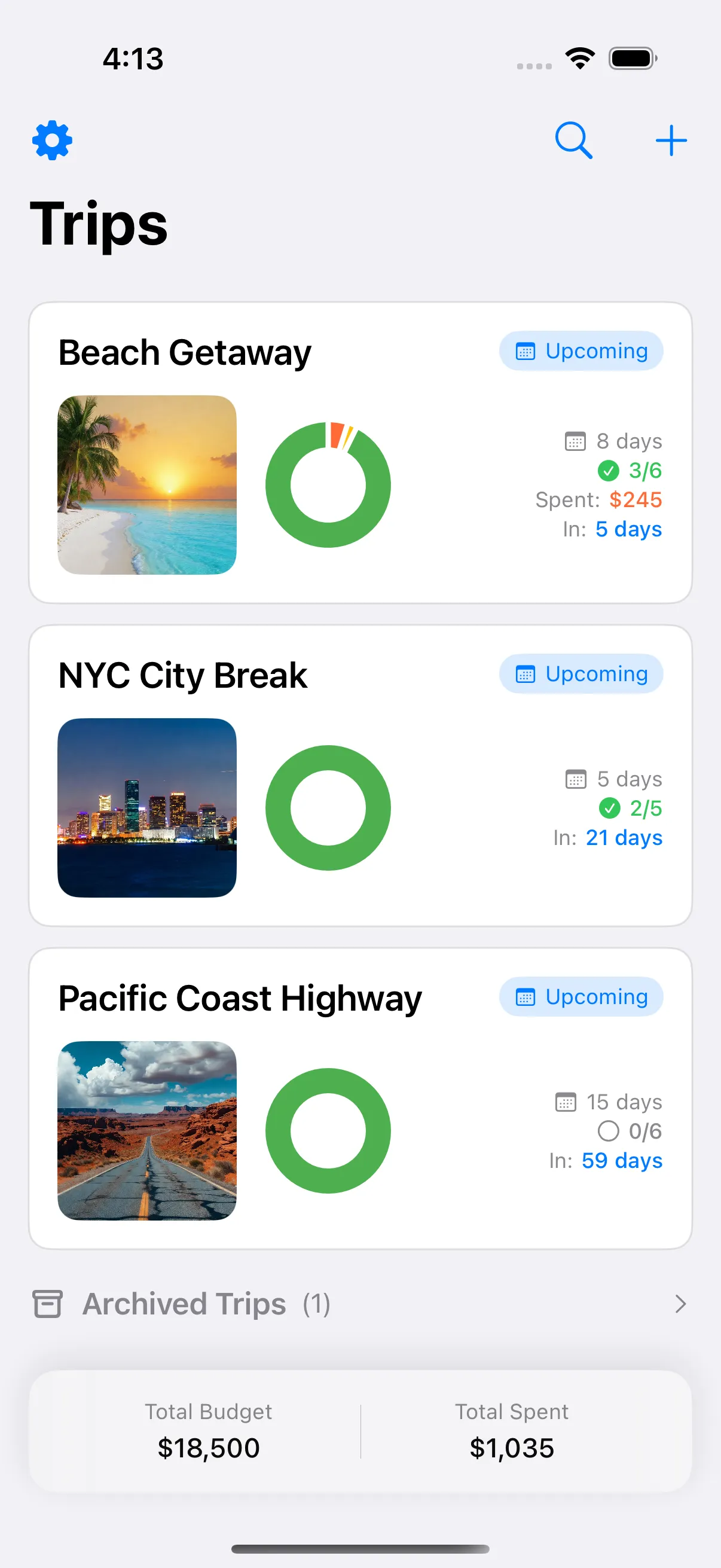
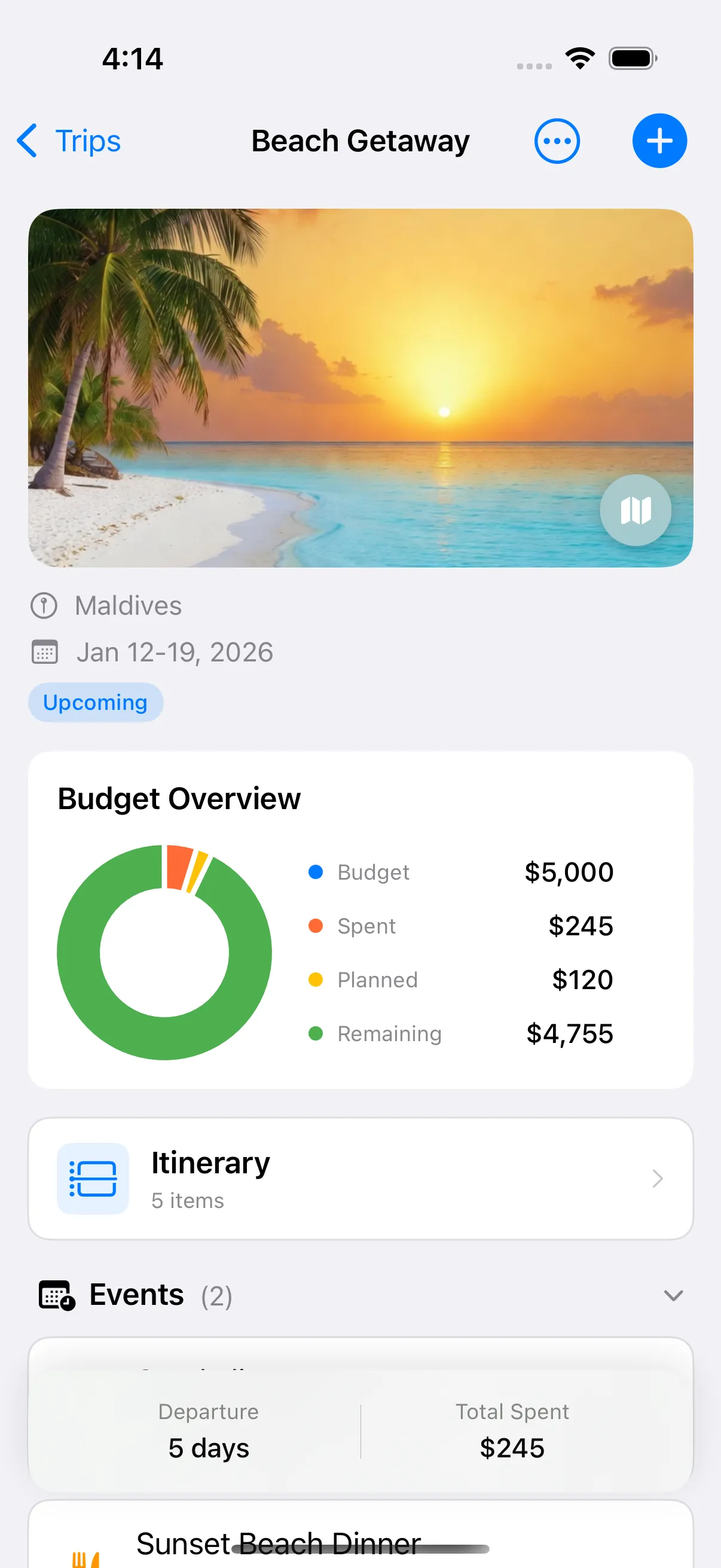
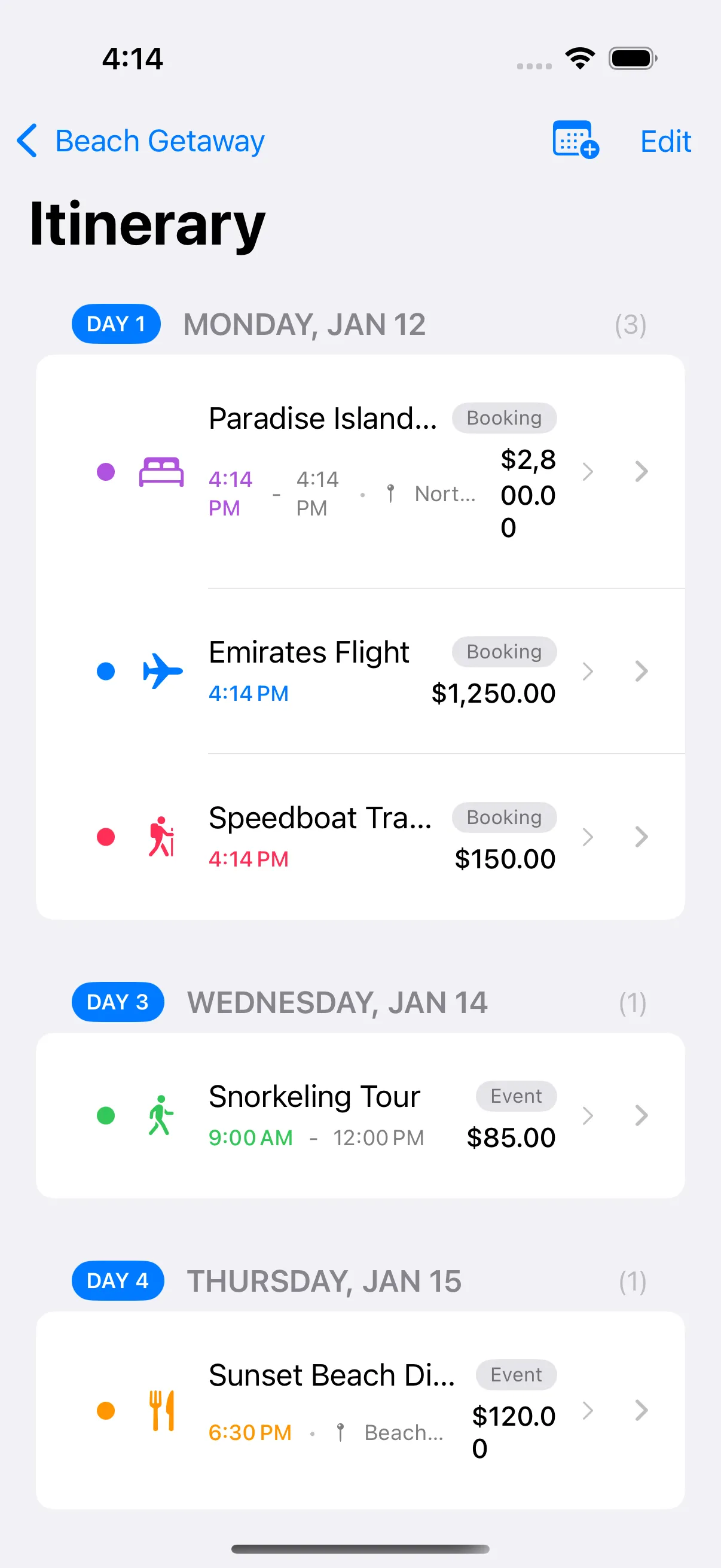
Travel Stories is a simpler, self-contained iPhone planner. One app holds the itinerary with maps, bookings, tasks, expenses against a budget, packing lists, and a travel diary with photos — all stored on your phone, working fully offline, with no account to create. Its pricing is the outlier: instead of a subscription, the full unlock is a one-time $1.99.
The pricing models are the sharpest dividing line, so let us get the verified numbers on the table first (checked July 2026, from each product’s own pricing pages):
- TripIt Pro: $49 per year, subscription, 30-day free trial. A free tier exists.
- Wanderlog Pro: $39.99 per year, sold as an annual plan. A free tier exists.
- Travel Stories Premium Lifetime: $1.99, one payment, no recurring charge. The free version includes one complete trip.
What does TripIt do best?
TripIt’s core strength has not changed in over a decade, and that is a compliment: email-forwarding itinerary automation. You book flights, hotels, and cars wherever you like, forward the confirmation emails, and TripIt assembles a clean master itinerary with dates, times, confirmation numbers, and addresses. Connect your inbox and even the forwarding step disappears. For anyone juggling many bookings across many suppliers — especially frequent business travellers — this is genuinely hard to beat.
The free tier covers that core: itinerary building from emails, calendar sync, basic sharing, maps, and up to three document uploads per trip.
TripIt Pro ($49/year) is where the airline-day features live:
- Real-time flight alerts for delays, gate changes, and cancellations — often faster than the airline’s own app
- Seat tracking that notifies you when a better seat opens up
- Fare monitoring that flags price drops on booked flights, which can mean refunds or credits
- Alternate flight search when things go wrong
- Airport walking directions to gates and baggage claims
- Reward-programme point tracking, and 25 document uploads per trip
Where TripIt is weak: it is an organiser, not a planner. There is no meaningful help deciding what to do at the destination, no budget tracking, no packing lists, and nothing resembling a travel journal. It organises the logistics layer of a trip and stops there. It also requires an account by design — the whole product is built around your email address.
What does Wanderlog do best?
Wanderlog is the strongest app of the three for collaborative planning on a map. Every trip is a live document: you and your co-travellers add places from Google Maps data, arrange them into days, and see the whole plan plotted geographically. Everyone edits simultaneously, comments, and votes with their edits — it is the closest travel planning gets to working in a shared Google Doc.
The free tier is generous: unlimited places, live collaboration, the combined itinerary-and-map view, importing flight and hotel reservations, and group expense tracking with cost splitting between travellers.
Wanderlog Pro ($39.99/year) unlocks the power-user layer:
- Offline maps and offline access to your full plan
- Route optimisation that reorders a day’s stops into the fastest sequence
- Automatic Gmail scanning to import bookings (its answer to TripIt’s forwarding)
- Export to Google Maps, an AI trip assistant, unlimited attachments, and dark mode
Where Wanderlog is weak: the features most people would call essential on the road — offline access above all — sit behind the Pro paywall. Planning a trip on the free tier at home works beautifully; landing in a foreign city without data and discovering your maps need Pro is the classic Wanderlog complaint. It also requires an account (your trips live on Wanderlog’s servers, which is what makes collaboration possible), and its journalling and memory-keeping features are thin.
Where does Travel Stories fit?
Travel Stories makes a deliberately different set of trade-offs. It is not trying to out-automate TripIt or out-collaborate Wanderlog. It is built for the traveller who wants one private, offline app for the whole arc of a trip — planning it, living it, and remembering it — without a subscription or an account.
What it covers, all in one app:
- Itinerary with maps — day-by-day plans, bookings, and tasks, with departure reminders 1-30 days out and a Home Screen countdown widget
- Budget and expenses — set a trip budget, log spending as it happens, and (with the one-time unlock) see visual spending charts; the method from our guide on how to budget for a trip maps directly onto it
- Packing lists — with over 100 built-in suggestions; the same engine runs free on the web if you want to see it first, including ready-made lists for a long-haul flight or a two-week Europe trip
- Travel diary — notes and photos captured per day, so the trip’s memories live next to its plan
- Share sheet capture — send bookings, links, and tips into the right trip from any iOS app
- Fully offline, no account — everything stays on your phone; there is no server and no cloud sync, in 14 languages
The pricing is the headline: the free version includes one trip with every feature, and the Premium Lifetime unlock — unlimited trips, spending charts, itinerary export to Apple Calendar, trip sharing and exports — costs $1.99 once. If you plan a couple of trips a year and want the whole thing organised in one place without another recurring charge, you can get Travel Stories on the App Store and be done with pricing decisions permanently.
Where Travel Stories is weak — honestly: it is iPhone-only (iOS 17 or later, no Android or iPad version), so mixed-platform groups are out. There is no email-forwarding automation — you add bookings yourself, helped by the share sheet but not replaced by it. And because data stays on-device, there is no live collaborative editing; you share a trip as an export rather than a live document. If any of those three is a dealbreaker, it is a dealbreaker, and one of the other two apps will serve you better.
TripIt vs Wanderlog vs Travel Stories: comparison table
| TripIt | Wanderlog | Travel Stories | |
|---|---|---|---|
| Price model | Free tier; Pro $49/year subscription | Free tier; Pro $39.99/year subscription | Free (1 full trip); $1.99 one-time lifetime unlock |
| Offline | Itinerary viewable offline | Offline maps and plans require Pro | Fully offline, including free tier |
| Account required | Yes | Yes | No |
| Itinerary | Auto-built from forwarded emails; strongest automation | Manual, map-first, drag-and-drop days | Manual, day-by-day with maps, bookings, and tasks |
| Budget tracking | No | Yes — group expenses with cost splitting | Yes — budget, expense log, charts with unlock |
| Journal / memories | No | Minimal (notes) | Yes — travel diary with photos |
| Collaboration | Itinerary sharing; Inner Circle on Pro | Yes — real-time group editing | No live editing; sharing via export |
| Platform | iOS, Android, web | iOS, Android, web | iPhone only (iOS 17+) |
How do the costs compare over time?
Subscriptions are small numbers that compound. Here is the straightforward maths for the paid tiers over a five-year horizon, at current prices:
| Timeframe | TripIt Pro ($49/yr) | Wanderlog Pro ($39.99/yr) | Travel Stories ($1.99 once) |
|---|---|---|---|
| 1 year | $49 | $39.99 | $1.99 |
| 3 years | $147 | $119.97 | $1.99 |
| 5 years | $245 | $199.95 | $1.99 |
Two honest caveats cut both ways. First, both TripIt and Wanderlog have real free tiers, and plenty of travellers never pay: TripIt Free still does email-forwarding itinerary building, and Wanderlog Free still does collaborative planning. The subscriptions buy the premium layer, not the core. Second, a subscription can be worth every cent — a frequent flyer whose TripIt Pro fare alert catches one price drop, or whose delay notification saves one missed connection, has covered the $49 several times over.
The comparison to make is with your own travel pattern: if you fly weekly, $49 a year for flight intelligence is cheap insurance. If you take two or three leisure trips a year and mostly need a place to keep the plan, the budget, and the memories, paying yearly for features you use twice is where the one-time $1.99 model wins. We have written a fuller breakdown of the subscription question in our guide to finding a trip planner app with no subscription.
Which app should you choose?
Choose TripIt if you book many trips with many suppliers and want the itinerary to build itself. Its email automation remains the best in the category, and TripIt Pro’s flight alerts are genuinely valuable for anyone who flies often. Accept that you will need an account, and that planning, budgeting, and journalling happen elsewhere.
Choose Wanderlog if you plan trips with people — friends, family, a partner who actually wants input. The shared map-and-itinerary view is the best collaborative planning experience of the three, and the free tier covers most group-planning needs. Budget for Pro if you want your maps offline when you land.
Choose Travel Stories if you are an iPhone traveller who wants planning, budgeting, packing, and a travel diary in a single offline app — and you would rather pay $1.99 once than sign up for anything. It will not forward-parse your emails or host a group editing session, but it covers the full life of a trip privately and works in airplane mode from day one.
And if none of the three fits exactly, the field is wider than this comparison — our round-up of the best trip planner apps covers the alternatives, including Google Maps-based workflows and spreadsheet planning.
The bottom line
TripIt vs Wanderlog is not really a head-to-head — it is automation versus collaboration, and the right answer follows from how you travel. Travel Stories sits beside them as the third option the subscription model ignores: fewer bells, no account, everything offline, and a price that you pay once and forget. Verify the current prices before you commit (they were $49/year, $39.99/year, and $1.99 one-time as of July 2026), pick the model that matches your travel pattern, and let the app disappear into the background — which is what a good trip planner should do.
Ready-made packing lists for this
Free, no sign-up: tick items off in the browser, print it, or adjust it to your own trip.
3-day business trip packing list
Three days of meetings in one cabin bag: one suit worn twice, two shirts, and the reason your presentation needs to exist in two places that aren't the cloud.
Long-haul flight carry-on essentials
What belongs in the bag at your feet on a ten-hour flight: hydration, compression socks, the last-hour reset kit, and the seat-back pocket rule that saves your passport.
Two-week Europe packing list
A multi-city Europe list built around the bag you carry up a fourth-floor walk-up: one laundry stop, three plug types, and 15°C of variation between north and south.
What to pack for a cruise
A cruise packing list built around the cabin: vertical storage on magnetic steel walls, scarce outlets, banned surge protectors, and the bag that arrives four hours after you do.
Or build one from scratch with the packing list generator.
Frequently asked questions
Is TripIt or Wanderlog better?
They solve different problems. TripIt is better if your priority is effortless organisation of existing bookings — you forward confirmation emails and it builds the itinerary, and Pro adds flight alerts and fare monitoring. Wanderlog is better if your priority is deciding what to do: it puts collaborative planning, saved places, and the itinerary on one shared map. Frequent business flyers tend to prefer TripIt; group leisure travellers tend to prefer Wanderlog.
How much does TripIt Pro cost in 2026?
TripIt Pro costs $49 per year as a subscription, with a 30-day free trial. The free TripIt tier still handles the core email-forwarding itinerary building; Pro adds real-time flight alerts, seat tracking, fare refund monitoring, alternate flight search, and reward-programme tracking.
How much does Wanderlog Pro cost in 2026?
Wanderlog Pro costs $39.99 per year, sold as an annual plan. The free tier already includes collaborative planning, unlimited places, and the map-based itinerary. Pro adds offline maps, route optimisation, Google Maps export, automatic Gmail import of bookings, an AI assistant, and unlimited attachments.
Is there a trip planner app without a subscription?
Yes. Travel Stories for iPhone charges a one-time $1.99 for its Premium Lifetime unlock instead of a recurring fee. The free version includes one trip with every feature — itinerary with maps, bookings, expenses, packing lists, and a travel diary — and the one-time purchase unlocks unlimited trips, spending charts, calendar export, and trip sharing. It works fully offline with no account.
Does Travel Stories replace TripIt or Wanderlog?
For some travellers, not all. It covers itinerary, budget tracking, packing lists, and a travel journal in one offline app, which is more than either competitor bundles. But it is iPhone-only, it does not auto-build itineraries from forwarded emails like TripIt, and it has no live collaborative editing like Wanderlog. If those two features are essential to you, the subscriptions earn their keep.
Keep reading

Best Trip Planner Apps for iPhone: An Honest Comparison
An honest look at TripIt, Wanderlog, Google Maps lists, Notion, and Travel Stories — who each trip planner app is really best for, from the maker of one.

How to Budget for a Trip: A Simple Travel Budget That Works
Build a travel budget in six categories, split it with a simple rule of thumb, add a 10-15% buffer, and track spending as you go. Worked example included.

Trip Planner Apps Without a Subscription (Yes, They Exist)
Tired of $40-60/year trip planner subscriptions? Here are the apps that are genuinely free or one-time purchases, and the trial traps to avoid.