How to Budget for a Trip: A Simple Travel Budget That Works
To budget for a trip, split your total into six categories — transport, accommodation, food, activities, local transit, and a buffer — estimate each one before you leave, and track actual spending against those numbers while you travel. A simple travel budget with a 10-15% buffer beats a single vague number every time, because it shows you exactly where the money is going and where you can adjust.
What should a travel budget include?
A travel budget only works if it covers everything the trip will actually cost — not just the big-ticket flight and hotel. The most common budgeting mistake is planning for two categories and getting quietly drained by the other four. Before you put numbers on anything, split the trip into these six categories:
- Transport to the destination. Flights, trains, ferries, or fuel and tolls for a road trip. Include seat selection, baggage fees, and airport transfers — they belong here, not in “surprises.” Checked-bag fees are the line most worth attacking: on a budget airline a return checked bag can cost more than a night’s accommodation, and a carry-on only packing list removes the charge entirely.
- Accommodation. Hotels, rentals, campsites, or hostels, including cleaning fees, city taxes, and resort fees that only show up at checkout.
- Food and drink. Every meal, coffee, snack, and drink for every day of the trip. This category is small per transaction and large in total, which is exactly why it gets underestimated.
- Activities. Museum tickets, tours, day trips, rentals, park entry fees — the things you are actually traveling for.
- Local transit. Metro passes, taxis, ride shares, bike rentals, parking. Rarely huge, but it is a real line and it adds up in cities.
- Buffer. A reserve of 10-15% of the total that is not assigned to anything. More on why below.
Some trips need extra lines — visas, travel insurance, vaccinations, pet sitting at home — but almost every expense you will meet fits one of the six. If you are still deciding where to go and when, sort that out first with a proper planning pass; our guide on how to plan a trip step by step covers the sequence.
How do you split a travel budget across categories?
Once you have a total you are willing to spend, you need to divide it. Here is a rule of thumb that works as a starting point for a typical flight-based leisure trip:
| Category | Share of budget | Example: $2,000 trip |
|---|---|---|
| Transport to destination | 30% | $600 |
| Accommodation | 25% | $500 |
| Food and drink | 20% | $400 |
| Activities | 10% | $200 |
| Local transit | 5% | $100 |
| Buffer | 10% | $200 |
This is a rule of thumb, not research — treat it as scaffolding and bend it to your trip. Ways it commonly shifts:
- Road trip: transport drops (fuel is usually cheaper than flights for a family), accommodation and food grow.
- Expensive city, cheap flight: a budget-airline hop to a capital city might flip the split — 15% transport, 35% accommodation.
- Food-first trip: if the restaurants are the point, give food 30% or more on purpose and enjoy it guilt-free.
- All-inclusive or prepaid packages: collapse accommodation and food into one line and let activities and the buffer take a bigger share.
The exact percentages matter less than the act of assigning them. A category with a number attached is a category you will notice overspending in.
A worked example
Say you have $2,000 for a one-week trip for two to a mid-priced European city. Using the split above:
- Transport ($600): two return flights plus airport trains. You find flights at $250 each — $500 total — leaving $100 for transfers and one checked bag.
- Accommodation ($500): six nights. That is about $83 per night, which points you at a simple hotel or a private rental room rather than a boutique hotel. Better to know that before you browse.
- Food ($400): roughly $57 per day for two, or about $28 per person. That supports a bakery breakfast, a casual lunch, and one modest restaurant dinner — with a plan to self-cater a couple of evenings if a special dinner is on the list.
- Activities ($200): two museum days, one walking tour, one day trip. Look up ticket prices now, not at the door.
- Local transit ($100): two 7-day transit passes usually fit comfortably, with a little left for a late-night taxi.
- Buffer ($200): untouched, unassigned, and only spent when reality demands it.
Notice what the exercise did: it turned “we have $2,000” into six concrete decisions you can act on months in advance.
Pre-trip estimating vs during-trip tracking
These are two different jobs, and a travel budget needs both.
Before the trip, you are estimating. Work bottom-up from real prices: actual flight quotes for your dates, actual nightly rates, actual ticket prices for the activities you care about. For food and transit, a quick search for typical restaurant and metro prices at the destination beats guessing. Write each estimate down next to its category. If the bottom-up total exceeds what you can spend, cut deliberately — one fewer activity, a cheaper neighborhood — instead of shaving 10% off every line and hoping.
During the trip, you are tracking. Every expense gets logged against its category the day it happens — ideally the minute it happens, because nobody accurately remembers Tuesday’s taxis on Friday. The point is early warning: if food is at 70% of its budget by day three of seven, you know today, while a couple of self-catered dinners can still fix it. If you only find out after you are home, the budget was decoration.
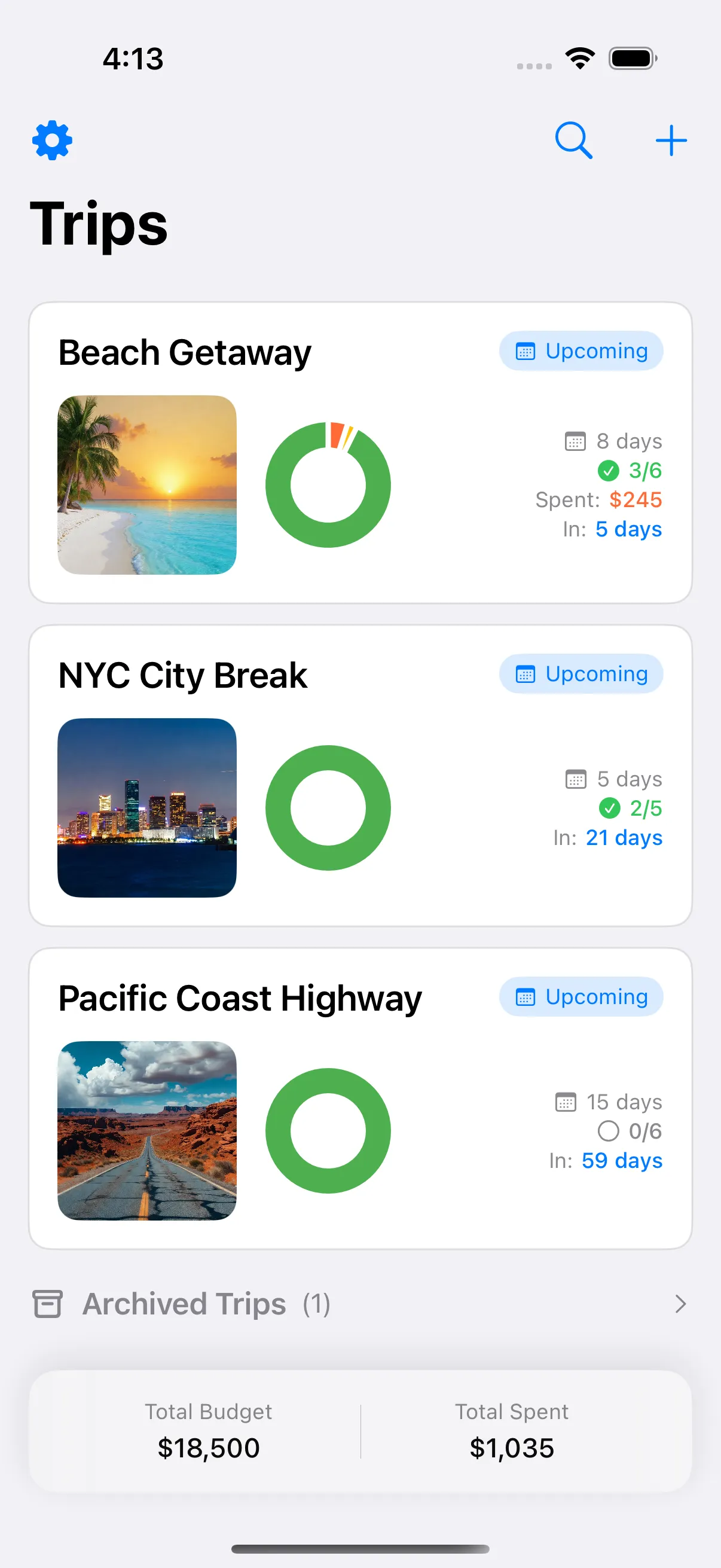
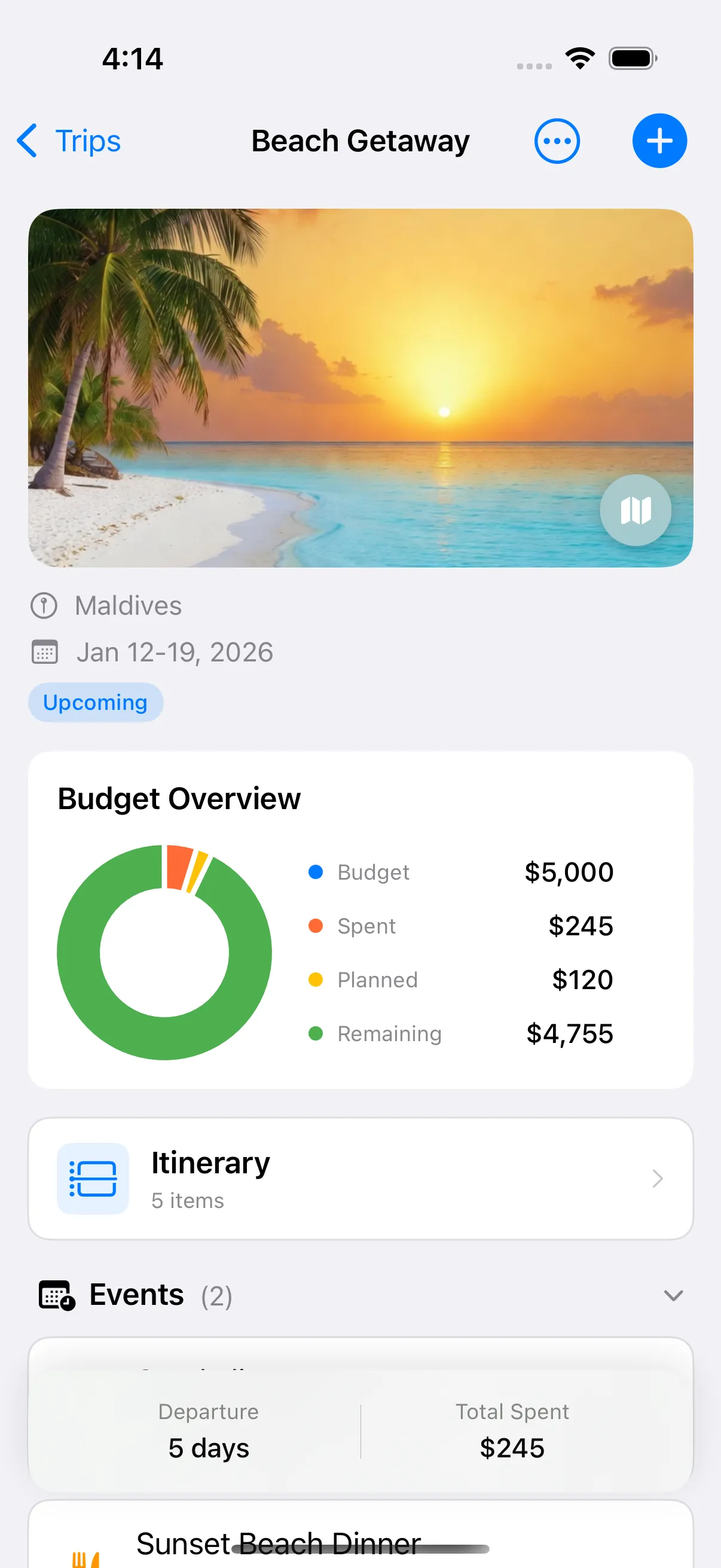
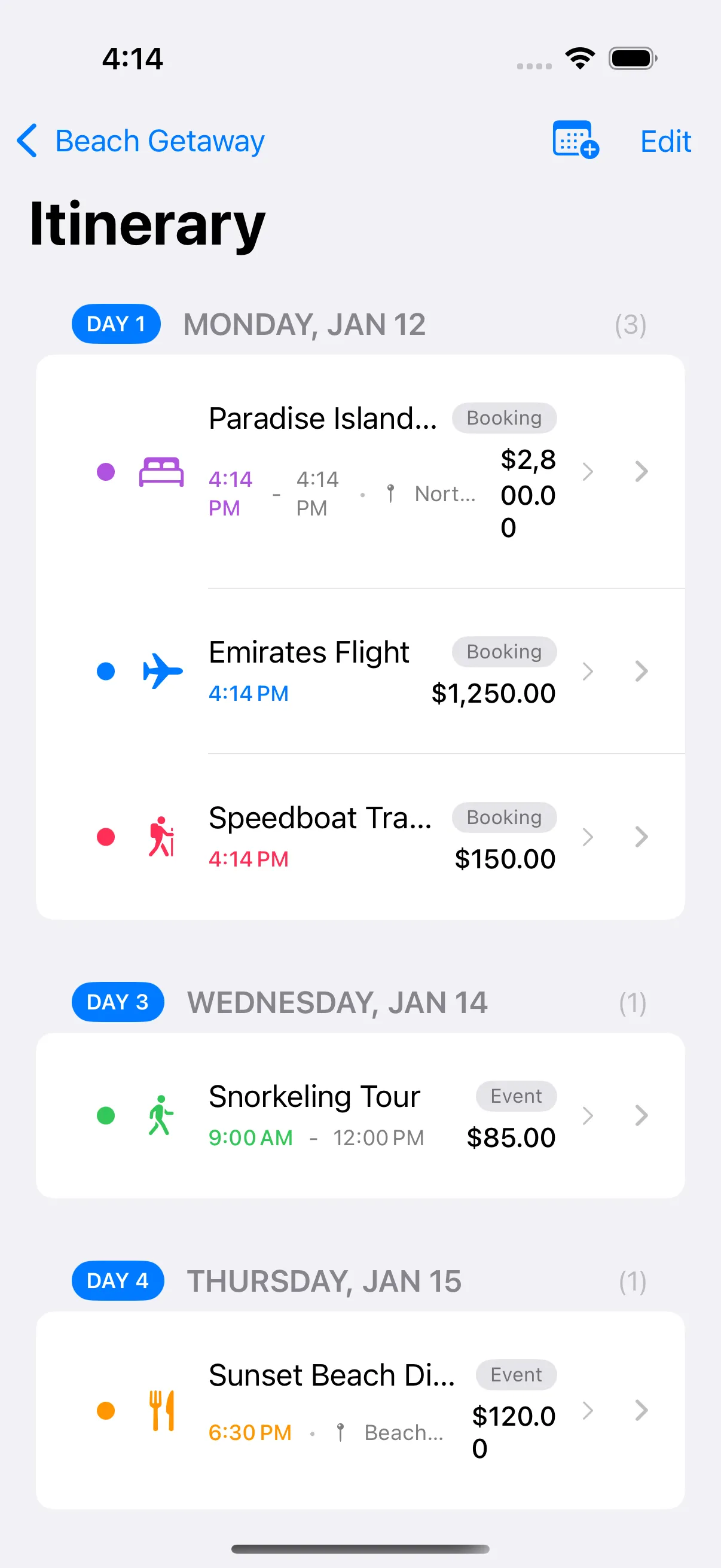
Paper works, spreadsheets work, but a phone app you already carry works best. If you want your budget, expenses, and the rest of your trip planning in one place, the free Travel Stories app lets you set a budget per trip, log expenses as they happen, and see spending against budget in a simple chart — offline, with no account to create.
Why keep a 10-15% buffer?
Because the alternative is worse. A trip with no buffer has two failure modes: either an unplanned cost blows the budget outright, or you spend the whole trip anxiously guarding against that possibility. Both ruin the fun you were budgeting for in the first place.
Things a buffer routinely absorbs:
- Baggage and seat fees that were not in the flight price
- A missed train that becomes a taxi
- A checkout-time city tax or cleaning fee you did not see when booking
- Weather forcing a paid indoor activity onto a beach day
- Medicine, sunscreen, a phone charger — the small emergency purchases
- One spontaneous “we’re only here once” splurge
Why 10-15% rather than 5% or 30%? At 5%, one moderate surprise wipes it out. Above 15-20%, you are effectively padding every category and losing the clarity that made the budget useful. Ten to fifteen percent is the range where the buffer is big enough to absorb a bad day and small enough to keep the rest of the numbers honest.
Two rules make the buffer work. First, do not assign it to anything in advance — a buffer with a plan is just another category. Second, if you dip into it, log that too, so you know how much is left.
What are the most common travel budget-killers?
The same handful of costs sink trip budgets over and over. Knowing them in advance is most of the defense:
- Airport spending. Food, water, and last-minute purchases at airport prices, twice per flight. Eat before, carry an empty bottle, and put a small realistic amount in the food line for it. Most of the rest — adapters, a charger, sunscreen — is bought at a markup because it was forgotten, which is a packing problem solved before departure, not a budgeting one.
- Card fees and bad exchange rates. Foreign transaction fees and “convenient” airport currency desks can quietly take a few percent of everything you spend. Check your card’s fees before you leave, and pay in local currency when a terminal offers a choice.
- Death by small stuff. Coffees, snacks, bottled water, souvenirs — individually trivial, collectively a real line. This is the category that tracking catches and memory never does.
- Taxis by default. One taxi is a convenience; taxis all week is a budget line you never planned. Look up the transit pass before you land.
- Checkout-surprise fees. Resort fees, cleaning fees, city taxes, parking charges. Read the total price at booking time, not the headline rate, and log the full amount.
- The last 48 hours. End-of-trip souvenir runs and “let’s do one more nice dinner” momentum land exactly when discipline is lowest. Decide in advance what the final days may spend.
- Prepaid amnesia. Money spent before departure — bookings, insurance, gear — often never enters the trip budget, making the trip look cheaper than it is. Log prepaid items in their categories when you pay for them.
None of these need to be eliminated. They need to be expected, which is a budgeting job, not a willpower job.
Envelope method or running total: which should you use?
There are two workable ways to run a travel budget day to day, and the right one depends on your temperament.
The envelope method gives each category a fixed allowance. Food gets $400 for the week and when it is gone, it is gone — or you make a conscious decision to move money over from activities. Historically this meant literal cash envelopes; today it means category budgets in an app or spreadsheet. Strengths: overspending is visible instantly and in context, and moving money between envelopes is a deliberate act rather than drift. Weakness: it needs slightly more bookkeeping, and rigid envelopes can feel fussy on a relaxed trip.
The running total tracks everything against one number: the whole trip gets $2,000, and you watch the single remaining balance. Strengths: dead simple, one number to check. Weakness: it hides where the money went. Being $300 over with three days left tells you that you have a problem, not that the problem is restaurants.
A practical middle path many travelers land on: run envelopes for the two categories where daily decisions happen — food and activities — and a running total for everything else, since transport and accommodation are mostly locked in before departure anyway. Whichever method you pick, the non-negotiable part is the same: log expenses as they happen and glance at the totals daily.
And before you leave, make sure the budget is not the only thing that is ready — run through a proper pre-departure checklist so a forgotten document does not become the buffer’s first casualty.
Put it into practice
Pick your total, split it across the six categories, price each one from real numbers, protect a 10-15% buffer, and log every expense while you travel — that is the entire system. Travel Stories, our free iPhone trip planner, gives you a budget, expense tracking with charts, and the rest of your trip in one offline app, so the plan you made at home is the one you follow on the road.
Ready-made packing lists for this
Free, no sign-up: tick items off in the browser, print it, or adjust it to your own trip.
Carry-on only packing list
Travelling with hand luggage only: the liquids bag is the real constraint, not the clothes. Solid swaps, the roll method, and the two things that never leave your body.
Hand luggage only packing list for a week
Seven days in a cabin bag, done by packing four days of clothes and washing once. The sink-wash routine, the fabrics that make it work, and the one-pair-of-shoes rule.
10-day backpacking packing list
Ten days out of one backpack: a four-day clothing rotation, packing cubes as an organisation system, and the dorm kit that decides whether you sleep.
Road trip packing list
A road trip list for the trip where you can overpack: the overnight bag that saves you unloading the boot, the documents police ask for, and the offline map that works in the canyon.
Or build one from scratch with the packing list generator.
Frequently asked questions
How much should I budget for a trip?
It depends on your destination, travel style, and trip length, so start from real prices rather than a universal number. Look up actual flight and accommodation costs for your dates, estimate a daily food and activity spend, and add everything up. Then add a 10-15% buffer on top. That bottom-up total is far more reliable than any generic per-day figure.
What is a good travel budget breakdown?
A common rule of thumb is about 30% for transport to the destination, 25% for accommodation, 20% for food, 10% for activities, 5% for local transit, and 10% held as a buffer. Treat it as a starting point, not a law. A road trip shifts money from flights to fuel, and a food-focused city break might double the food share.
Why do I need a buffer in my travel budget?
Because something unplanned happens on almost every trip: a missed connection, a checked-bag fee, a rainy-day activity, or a dinner that ran long. A 10-15% buffer absorbs these without forcing you to cut the rest of the trip. If you come home without touching it, it simply becomes savings.
Should I track expenses during my trip or just plan beforehand?
Do both. The pre-trip estimate sets your targets, but only during-trip tracking tells you whether you are actually on pace. Logging each expense takes a few seconds and lets you correct course on day three instead of discovering the damage on your credit card statement after you get home.
What is the envelope method for travel budgeting?
You give each category its own fixed allowance — an envelope — and when a category is empty, you stop spending in it or consciously move money from another envelope. The alternative is a running total, where you track everything against one overall number. Envelopes give more control; a running total is simpler. Many travelers combine them: envelopes for food and activities, one shared pot for the rest.
Keep reading

Best Trip Planner Apps for iPhone: An Honest Comparison
An honest look at TripIt, Wanderlog, Google Maps lists, Notion, and Travel Stories — who each trip planner app is really best for, from the maker of one.

How to Plan a Trip Step by Step: A Complete 9-Step Guide
Learn how to plan a trip step by step — pick dates, set a budget, book transport, build an itinerary, pack, and track spending in one simple system.
Travel Checklist: Everything to Do Before Leaving Home
The complete pre-departure travel checklist — what to do 2 weeks out, 1 week out, the day before, and the day you leave, from documents to door locks.