Notion Travel Planner Template vs an Actual Trip App
A Notion travel planner template is three parts: a trip hub page, a day-by-day itinerary database, and a budget table. It is free and genuinely flexible — but it lives in a browser, needs an account, and degrades badly on a phone offline. If you plan in long sessions at a desk, copy the template below and use it. If your planning happens on the train, in the airport, and in hotel rooms with flaky wifi, a purpose-built app does the same job with zero setup.
What a Notion travel planner template actually is
Ignore the marketing screenshots. Strip any Notion travel template down and it is one of three things:
- A page with headings — “Itinerary”, “Budget”, “Packing” as empty text blocks. This is a document, not a template.
- A database — rows for days or places, columns for time, cost, notes. This is the useful kind.
- A connected system — a trip hub page linked to an itinerary database, a budget database, a packing checklist, and a documents section, all on one page. This is what the good ones sell or share, and it takes the author of the template an afternoon to set up.
Most free templates you will find are category 1 or 2. The template below is category 3 — paste it into a fresh page and you have the full system.
The free template (copy, paste, go)
Paste this into a fresh Notion page. Notion keeps the structure; you fill in the rows.
# [Destination] — [Dates]

## Trip overview
- Travelers:
- Depart:
- Return:
- Base address / hotel:
- Must-dos (3 max):
- Money: card / cash / eSIM
- Documents: passport · tickets · booking confirmations · insurance

## Itinerary
| Day | Date | Morning | Afternoon | Evening | Food planned | Notes |
|-----|------|---------|-----------|---------|--------------|-------|
| 1   |      |         |           |         |              |       |
| 2   |      |         |           |         |              |       |
| 3   |      |         |           |         |              |       |

## Budget
| Category | Planned | Actual | Difference |
|----------|---------|--------|------------|
| Flights  |         |        |            |
| Stay     |         |        |            |
| Food     |         |        |            |
| Transport|         |        |            |
| Activities|        |        |            |
| Buffer   |         |        |            |
| TOTAL    |         |        |            |

## Packing
[ ] Passport & ID
[ ] Tickets & confirmations (printed + offline)
[ ] Cash / cards
[ ] eSIM or SIM
[ ] Charger + adapter
[ ] Meds + plasters
[ ] 3 outfits + 1 dressy
[ ] Toiletries (liquid kit for carry-on)
[ ] Day bag
[ ] Rain shell

## After the trip
[ ] Log final expenses
[ ] Organize photos
[ ] What to do differently next time
Two rules make it survive to departure day: keep the must-dos list at three items (five always becomes seven, and the list stops meaning anything), and fill the planned column of the budget before you fly — a budget table without a planned number is just an expense log with extra steps. Our guide on budgeting for a trip has the actual numbers per country type if you want anchors.
About five minutes of pasting and typing, and the planning system exists. That is the whole pitch of templates: someone else did the boring structure work.
Where the template wins
Be honest about the good parts, because they are real:
- Free, genuinely. Notion’s free plan covers a single traveler’s planning indefinitely. No tier gating mid-trip, no paywall on the budget table.
- Flexible. Want a column for “energy level this day” or a linked database of every trip you have ever made? You can build it. A fixed app gives you its schema; Notion gives you the database.
- Great for long sessions. Researching, comparing options, mapping days out over a weekend at a desk — a big screen with a well-structured page beats a phone form.
- Shareable with collaborators. A travel companion can open the page and edit the itinerary. If you are planning a group trip with real co-decisions, this is a legitimate point in Notion’s favour that most trip apps do not match.
- Cross-device. Build on a laptop, check it on a phone, both logged into the same account.
If your trip is a project — a month-long slow travel trip, a group of six, a frequent flyer who plans at a desk — the template approach earns its keep.
Where the template falls over
And here is the part the template gallery pages never show you:
- Setup is the product. Every “free template” is a blank canvas with a tutorial. Fifteen to thirty minutes of configuring databases and links before you have planned a single day. Multiply by every trip, because most templates are per-trip.
- The phone is the wrong device. Trip planning does not happen at a desk after the first hour. It happens on the train, in the taxi, in a hotel room at 11 p.m. deciding tomorrow’s museum slot. Notion’s mobile experience is browser-speed: it loads, it scrolls, it occasionally waits for a spinner. In an airport queue with one bar of signal, a template that cannot load is a template that does not exist.
- Offline is the weakest point. Notion’s offline support on mobile is limited to recently opened pages and is not reliable for databases. Airports, foreign trains, mountains — the exact places an itinerary must work — are the exact places the template needs a signal.
- Nothing connects after the trip. This is the big one. Your Notion page after a trip is a page with a filled-in table. It does not hold the photos you took, the notes you scribbled on the back of a boarding pass, or the actual spending vs planned comparison as anything but your own arithmetic. The trip ends and the document becomes a receipt drawer.
- Every number is manual. The budget table subtracts nothing, totals nothing, and remembers nothing. Every actual expense is typed by hand, and the difference column is arithmetic you do with a calculator on a Tuesday night at home.
- The packing block is the same list every trip. The checklist above is generic by necessity — a template cannot know you are going somewhere cold for ten days with a child. Anything that adjusts to the trip has to be generated, which is why we built a free packing list generator that takes trip type, length, climate, carry-on-only and kids as inputs and produces a different list for each; a two-week Europe trip and a 3-day business trip genuinely should not share a checklist.
None of these are Notion’s fault — it is a general-purpose tool doing a specific job. But “general-purpose” is exactly the trade you are making, and it costs you the two things a trip actually needs: it has to work on the phone where you are, and it has to still mean something after you land.
The app option, honestly
The comparison people actually want: template vs a purpose-built trip app. Here is the honest table:
| Notion template | Trip app | |
|---|---|---|
| Setup time | 15-30 min per trip | A few minutes |
| Cost | Free | Free tier, one-time unlock |
| Desktop planning | Excellent | Limited |
| Phone experience | Browser-speed, inconsistent | Native, fast |
| Offline | Unreliable | Built for it |
| Budget math | Manual | Automatic |
| After the trip | A filled-in page | The trip as a record |
| Group collaboration | Strong | Varies |
The template is the better tool for planning at a desk. The app is the better tool for the trip itself — and, arguably, for what you do the week after you get home. A free pre-departure checklist works in either world, which is a nice reminder that the habits matter more than the tool.
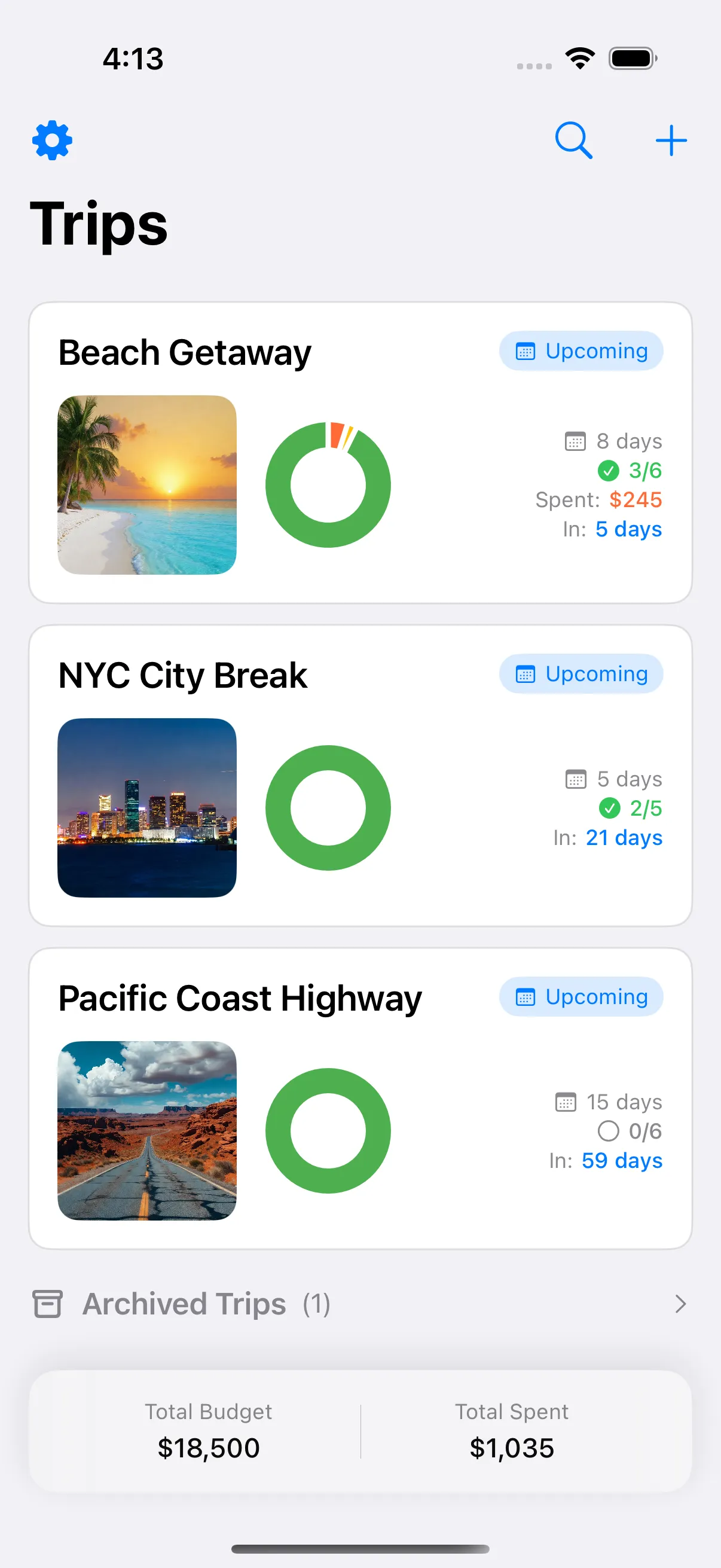
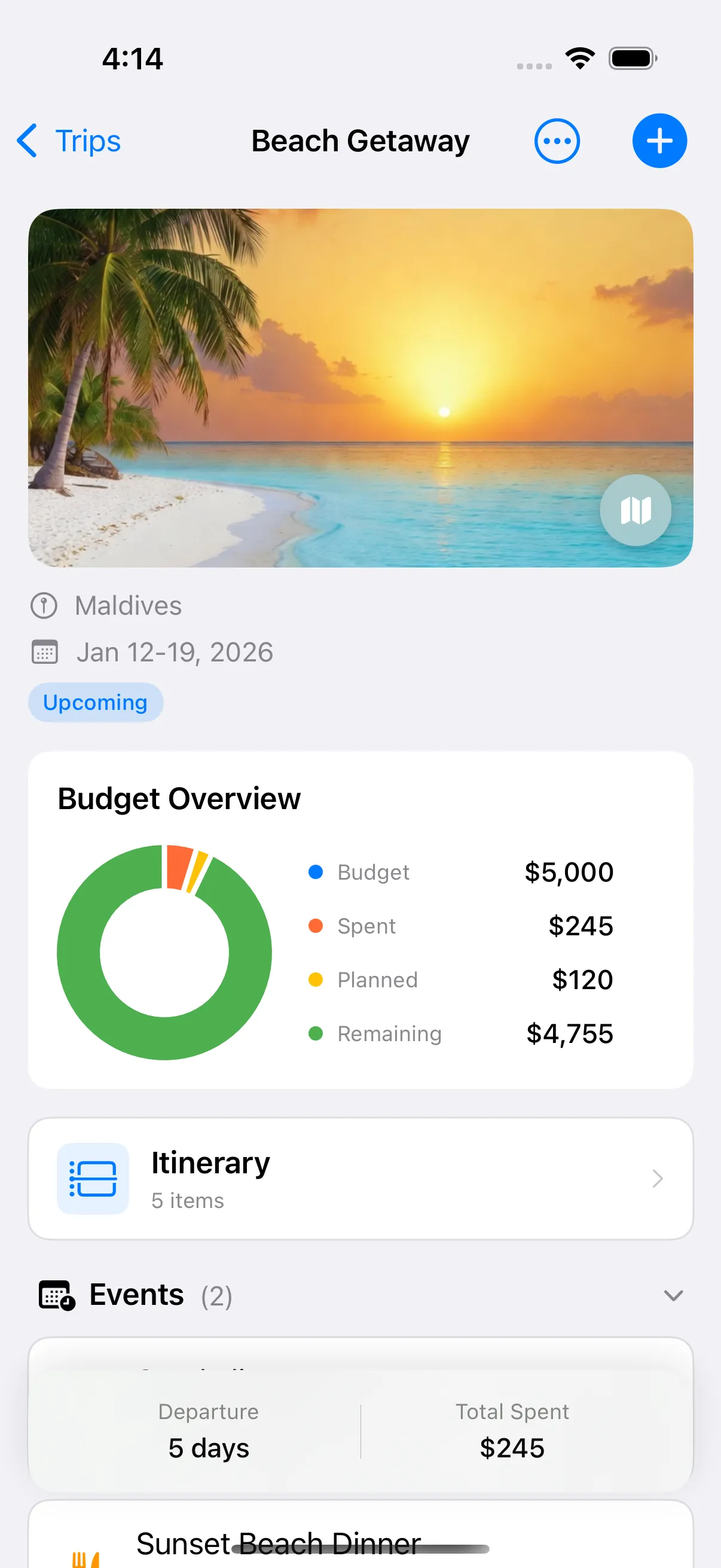
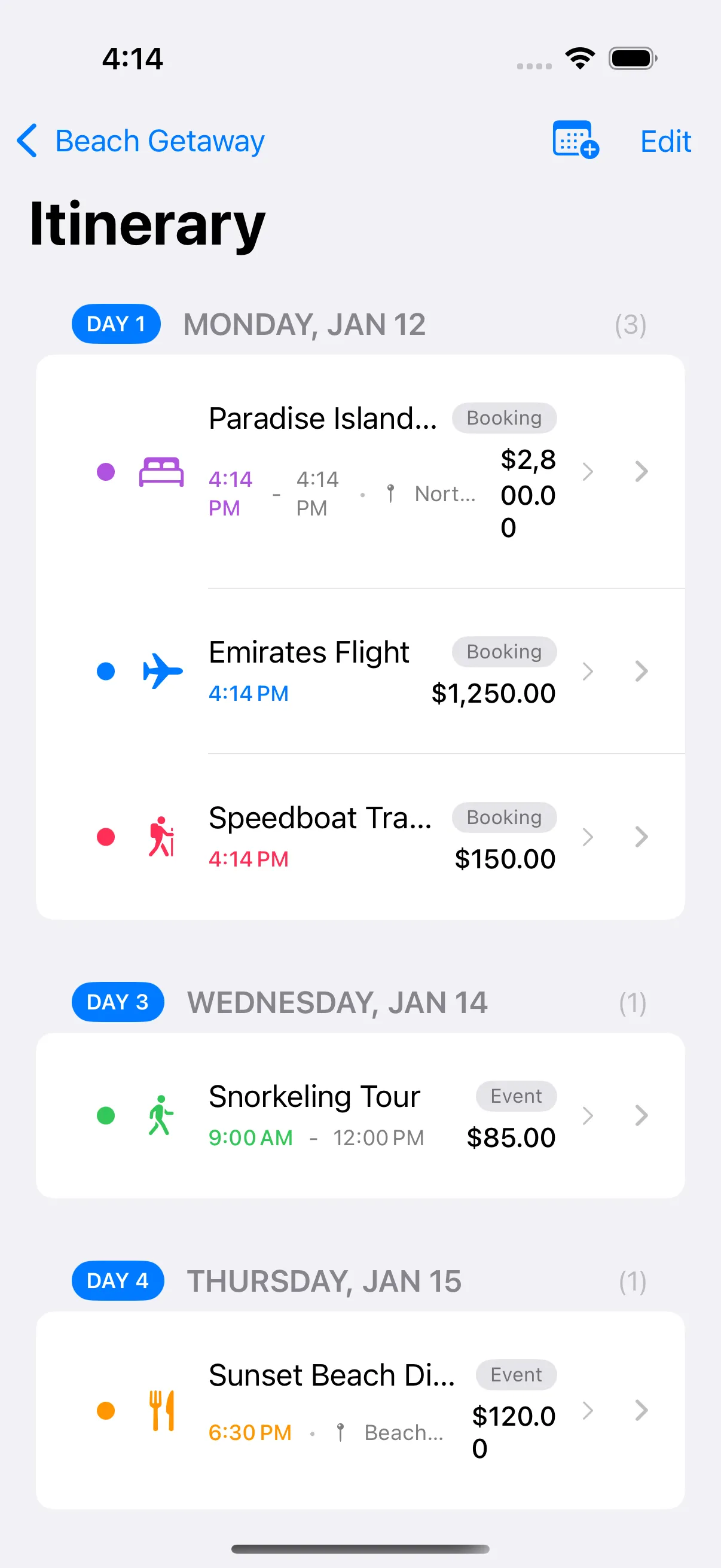
If that second column sounds like how you actually travel, the Travel Stories app holds the same three jobs — day-by-day itinerary, budget with actual-vs-planned tracking, and documents and packing lists — in one place on your iPhone, offline, with nothing to configure. Free for one trip with every feature included; Premium is $1.99 once, not a subscription. The honest version: it is not a canvas. You cannot add a “wine ratings” database. But it does not need one.
Which should you use?
- You plan in long desk sessions and love building your own system: use the template above. It is free, it works, and your setup time is a feature not a bug.
- You plan in bursts on a phone and travel away from wifi: use an app. The template will fail you exactly when the itinerary matters most.
- You want both: do the deep planning in Notion over the weekend — research, day plans, the must-do list — and copy the final itinerary into an app before you fly. That is the hybrid a lot of serious travelers actually run: the canvas for planning, the app for the trip and the memory after.
- You plan group trips with real co-decisions: Notion’s collaboration is a real advantage; check which trip apps share trips before ruling them out.
The template is in the box above — copy it, and if it serves you, it will serve you for years. If you would rather the trip just be on your phone from the first flight, that is what the app row in the table is for. Either way, the next step is the same: our step-by-step guide on planning a trip tells you what to put in days 1, 2 and 3, regardless of the tool you pick.
Ready-made packing lists for this
Free, no sign-up: tick items off in the browser, print it, or adjust it to your own trip.
Weekend city break packing list
A two-night city break packed into one cabin bag. What a 48-hour wardrobe actually looks like, and why checking a bag costs you a quarter of the trip.
3-day business trip packing list
Three days of meetings in one cabin bag: one suit worn twice, two shirts, and the reason your presentation needs to exist in two places that aren't the cloud.
Two-week Europe packing list
A multi-city Europe list built around the bag you carry up a fourth-floor walk-up: one laundry stop, three plug types, and 15°C of variation between north and south.
Digital nomad packing list
A packing list for working while travelling: the desk setup that fits a cabin bag, one charger instead of four, connectivity with a real fallback, and the documents borders ask for.
Or build one from scratch with the packing list generator.
Frequently asked questions
Is there a free Notion travel planner template?
Yes — there are hundreds, and the copy-paste template in this post is one of them. The official Notion template gallery has free trip templates too, but most are thin: a page with a few headings. A usable one has three parts: a trip hub with destination, dates and links, a day-by-day itinerary database, and a budget table with per-day and per-category rows. If a template does not have those three, it is a starting point, not a system.
Is Notion good for trip planning?
At a desk, yes. Notion is free, flexible, and great for long planning sessions — researching, comparing, writing day plans. Where it falls short is the trip itself: it needs an account and loads best in a browser, the mobile app is slow with limited offline access, and anything built in the free plan does not sync to offline use reliably. Most travelers plan in bursts at home and then need the itinerary in the taxi, the hotel, and the airport — that is where Notion is weakest and a dedicated app is strongest.
Notion or a spreadsheet for a trip itinerary?
Same trade-off, different skin. A spreadsheet is faster to start but harder to share and ugly on a phone; Notion is prettier and better for sharing with travel companions, but the planning work is identical — you build the rows, columns and links yourself and maintain them by hand. Neither one pulls your trip together after it happens: both stay a blank document once you land, whereas a trip app keeps the itinerary, expenses and photos as one finished record.
Can I use Notion templates offline?
Partially. Notion's mobile apps allow limited offline access to pages you have opened recently, but the experience is inconsistent — databases in particular can fail to load without a connection, and you cannot rely on it mid-trip. If offline access is a hard requirement (airports, mountains, foreign trains), a template-based system is the wrong tool; that is the one thing a native app does by design.
How much does a Notion travel planner cost?
The free plan covers most personal trip planning: unlimited pages and databases for personal use. Notion's paid plans start around $10-15/month and only matter for shared workspaces with many members. The real cost is not the subscription — it is the setup time (15-30 minutes to build a proper system from a thin template) and the maintenance (updating the budget table by hand on every trip day). A trip app trades that setup for a few minutes of entering the basics.
Keep reading

How to Budget for a Trip: A Simple Travel Budget That Works
Build a travel budget in six categories, split it with a simple rule of thumb, add a 10-15% buffer, and track spending as you go. Worked example included.

How to Plan a Trip Step by Step: A Complete 9-Step Guide
Learn how to plan a trip step by step — pick dates, set a budget, book transport, build an itinerary, pack, and track spending in one simple system.

Trip Planner Apps Without a Subscription (Yes, They Exist)
Tired of $40-60/year trip planner subscriptions? Here are the apps that are genuinely free or one-time purchases, and the trial traps to avoid.